

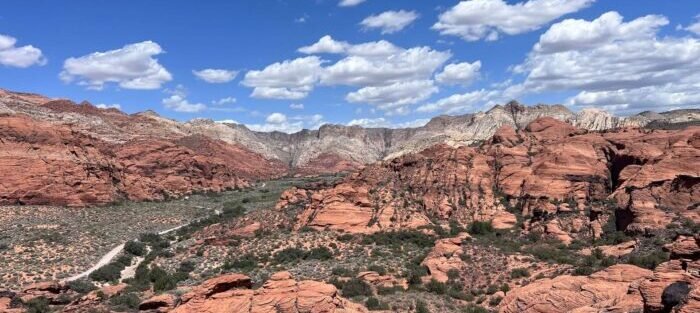
Hike the Lava Tube Trail in Snow Canyon State Park near St. George, Utah: 2 miles, 400 feet of gain across hardened lava flows to ancient lava tubes you can enter and explore. Moderate, dog-friendly.
Quick Facts
| Trail Name | Lava Tube Trail |
| Location | Snow Canyon State Park, near St. George, Utah |
| Coordinates | 37.2220° N, 113.6420° W |
| Distance | ~2 miles roundtrip |
| Elevation Gain | ~400 feet |
| Difficulty | Moderate (lava rock scrambling; uneven footing) |
| Time | 1.5–2.5 hours |
| Dogs Allowed | Yes, on leash |
| Fee | $15 per vehicle to enter Snow Canyon State Park |
| AllTrails | View on AllTrails |
How to Get There
From St. George, take UT-18 north and follow signs to Snow Canyon State Park. The park entrance is about 20 minutes from downtown. Inside the park, drive north on Snow Canyon Drive to the designated Lava Tube Trail parking area. The trailhead is well-marked from the parking lot. From Las Vegas: I-15 north about 1.5-2 hours to St. George, then north on UT-18. From Salt Lake City: I-15 south about 4-4.5 hours to St. George. Snow Canyon is a natural first or last stop on any St. George area visit.
Parking Information
Designated lot off Snow Canyon Drive with adequate space. The park sees peak use on spring and fall weekends; arrive before 8 a.m. on busy days. The $15 per vehicle entry fee applies at the park gate. A Utah State Parks annual pass is available for frequent Utah state park visitors. The Lava Tube parking lot is separate from the main visitor area; follow signs inside the park. 
Cell Service and Navigation
Cell coverage is present throughout Snow Canyon given the proximity to St. George. Download AllTrails offline as standard practice. The Lava Tube Trail is well-marked; navigation is not complex. GPS is useful for confirming the approach to the tubes if you’re moving across the lava flow terrain where the trail can be less obvious on dark rock.
What to Expect on the Lava Tube Trail
The trail departs the trailhead and immediately begins crossing hardened basalt lava flows. This is the visual contrast that makes Snow Canyon distinctive: the black volcanic rock of the lava flows against the red and white Navajo Sandstone canyon walls. The lava flows in Snow Canyon are relatively recent geologically, thought to be less than 10,000 years old, which is young enough that the lava surface is still jagged and rough rather than smoothed by erosion. The terrain is uneven, sharp-edged in places, and requires attention to footing throughout. Sturdy shoes with good grip are the key footwear requirement: trail runners or hiking boots that handle uneven rocky surfaces. Lava rock is rough and abrasive; thin-soled shoes are uncomfortable and provide poor traction on the jagged surface. Lava tubes form when the surface of a lava flow cools and solidifies while the molten lava beneath it continues to flow, eventually draining out and leaving a hollow tube behind. The lava tubes in Snow Canyon State Park are open for exploration: you can enter the tubes, walk or crouch through the interior, and see the smooth tube walls and ceiling created by the flowing lava. The tubes are dark. Bring a headlamp or flashlight for tube exploration; the entrance is dark and the depth of exploration depends on your light source and comfort with confined spaces. The tube interior is significantly cooler than the desert surface above it, a relevant feature in summer. For photography: the lava tube entrance with the canyon visible beyond it is the classic Snow Canyon lava tube composition. Inside, a wide-angle with a light source to illuminate the tube walls. Morning light from the east illuminates the lava flow terrain and the canyon walls around the tube entrances before the overhead light flattens the texture. 
Trail Difficulty and Length
Lava Tube Trail is approximately 2 miles roundtrip with 400 feet of gain. Moderate is accurate: the lava rock surface requires sustained attention to footing that earns the rating even without a demanding elevation profile. Budget 1.5-2.5 hours depending on how much time you spend in the tubes.
Dog Friendly?
Yes. Dogs are permitted on leash. The lava rock surface is rough on dog paws; inspect periodically and redirect dogs to smoother sections where available. Dogs cannot easily navigate the tube interiors; if the tube exploration is the primary goal, a human-only visit or leaving dogs at the tube entrance with a secure leash anchor is appropriate. Bring water for dogs. 
What to Bring
Water: 2 liters for a 2-mile moderate desert hike. Sturdy shoes with grip, this is more critical on the Lava Tube Trail than on most other Snow Canyon trails. A headlamp or bright flashlight for tube exploration. Sun protection for the exposed lava flow sections. Dog paw protection (booties or close paw monitoring) for the sharp rock surface.
Best Time to Hike the Lava Tube Trail
Spring (March through May) and fall (September through November) offer the most comfortable temperatures. The lava tubes provide a cool dark interior that makes them more pleasant to explore in summer heat than an exposed ridge hike; the approach across the lava flow is the hot section. Early morning starts before 8 a.m. are appropriate for summer visits. The lava flow terrain reads differently at different light angles: early morning from the east highlights the texture of the basalt surface. The contrast between the black lava rock and the red canyon walls is most photogenic in soft morning or late afternoon light.
Rules and Regulations
Stay on designated trails and within the open hiking areas across the lava flow. Do not remove rocks, including lava rock samples. Leave No Trace throughout. Dogs on leash. $15 per vehicle park entry. Fires only in designated campground areas. 
Where to Stay Near St. George
St. George has full city hotel infrastructure. For points travelers, check available Marriott Bonvoy properties in St. George, IHG Rewards hotels in St. George, and Hilton Honors options in St. George.
Camping Nearby
Snow Canyon State Park has a developed campground inside the park. Reservations through reserveamerica.com. In-park camping enables early Lava Tube starts before peak visitor traffic and gives access to morning light on the canyon walls and lava flows. Good state park camping in a geologically interesting setting.
Nearby Adventures
The full Snow Canyon trail catalog: Petrified Sand Dunes, Butterfly Trail, and Jenny’s Canyon. Each needs a standalone post. All four Snow Canyon trails can be combined in a full day park visit. Babylon Arch in Red Cliffs NCA is a nearby option: an arch trail in the Red Cliffs National Conservation Area north of St. George. Quail Creek SP Overlook and the Red Reef Trail complete the St. George area circuit. Zion National Park is about 40 minutes east on UT-9 from Snow Canyon’s eastern access. Snow Canyon as a half-day morning stop before heading to Zion is a natural itinerary for visitors approaching Zion from the St. George direction.
Plan This Hike
AllTrails has the Lava Tube Trail mapped with offline capability and condition reports. Plan your hike on AllTrails and download before heading into the park.
Chase the Quiet
Snow Canyon’s landscape is red and white Navajo Sandstone and then suddenly there’s black lava cutting across it. The lava is younger than the sandstone by hundreds of millions of years; it flowed over the canyon landscape after the canyon was already shaped and cooled in place. Walking the Lava Tube Trail is walking the seam between those two geological time periods: the old canyon and the young volcanic intrusion that crossed it. Inside the tubes, you’re inside the younger thing, the molten rock that hardened around empty space. That’s a specific kind of geological time travel that not many trails deliver in such a compact and accessible package.
Support the Adventure
To make your walls less boring, check out my photography portfolio and bring a piece of the wild and my story into your home. If you’d like to fuel future adventures, you can donate a coffee on Ko-Fi. Every cup keeps me chasing sunrises and stories. When you shop using my affiliate links, every click helps support this blog at no extra cost to you. It’s a small way to keep Unicorn Adventure alive and kicking while I keep exploring. Subscribe to my mailing list for future updates, new stories, and behind-the-scenes adventures. Stay connected with me on Instagram and Facebook for more photos and daily inspiration. Thanks for being part of the journey, Unicorn Squadron! 
Theo Maynard is a landscape photographer and adventure blogger based in Salt Lake City. He chases remote desert and mountain light across the American West, documents it all solo, and shares the journey through Unicorn Adventure. He’s on the autism spectrum, and that’s not a footnote, it’s the whole story. He creates to inspire others to get outside, chase what lights them up, and live their best possible life. Unapologetically himself.