


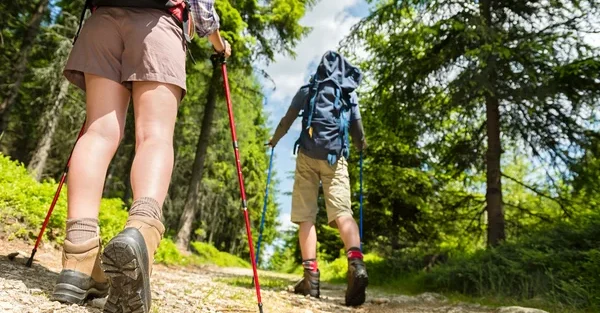
The Best Trekking Poles for Hiking (From Someone Who Hikes Alone and Can’t Afford a Blown Knee)
Trekking poles were not something I thought I needed. I hiked without them for years. Then I descended Bright Angel Trail in the Grand Canyon, 8.9 miles and 3,034 feet of elevation gain, with nothing but my own joints absorbing every step. I limped back to Estes and could barely walk the next morning. That was the last time I hiked without poles.
I’m autistic, and I adventure solo across the American West. No hiking partner. No one to grab my pack if I slip on loose scree. No one to help me hobble out if something goes wrong four miles into a canyon with no cell service. Trekking poles give me two extra points of contact on terrain that doesn’t care whether I make it home. They also give my brain a rhythm. Plant, step, plant, step. It’s meditative. It keeps my breathing steady and my thoughts organized when the trail gets steep and the world gets loud.
I use poles on every hike now. Desert sandstone in Moab. Alpine granite in the Uintas. Volcanic rock in Death Valley. Slick clay in Grand Staircase-Escalante. These are the picks that have survived all of it.
The Best Trekking Poles
1. Cascade Mountain Tech Aluminum Trekking Poles, Best Budget Option
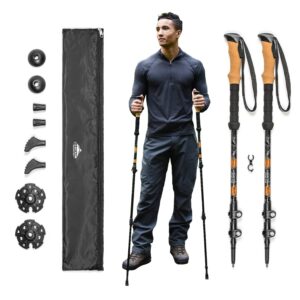
Cork grips, quick-lock adjustments, and a full accessory kit with mud baskets, snow baskets, and rubber tips. Under $40. The cork soaked up sweat on the Navajo Loop and Queens Garden Trail at Bryce Canyon (3.0 miles, 652 feet of gain) even in July heat. The quick-lock held firm on every adjustment.
The aluminum adds weight compared to carbon fiber, about 19 ounces each. On longer pushes you’ll notice that. But for the price, these are the poles I recommend if you’re just getting started and want reliability without overthinking it.
2. TrailBuddy Trekking Poles, Best for Durability
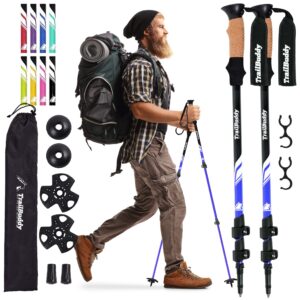
The lever locks are the standout feature. I adjusted them one-handed with gloves on during a cold morning at Marlette Lake near Tahoe (5.9 miles, 1,617 feet of gain from Chimney Beach). They stayed locked the entire descent. The aluminum bends instead of snapping, which matters on rocky terrain like Cathedral Rock in Sedona (1.2 miles, 741 feet of gain) where you’re wedging poles into tight crevices. Cork grips break in nicely over time. Heavier than carbon fiber, but a pole you can trust not to fail on you.
3. Trekology Trek-Z Collapsible Poles, Best for Travel
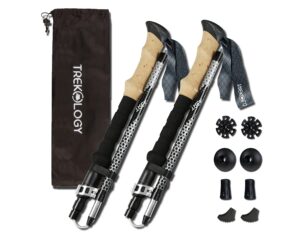
These fold to 15 inches and weigh about 11.5 ounces each. I stashed them in my daypack at the Mesquite Flat Sand Dunes in Death Valley and pulled them out for the Golden Canyon and Gower Gulch Loop (6.4 miles, 1,082 feet of gain) without missing a beat. The tri-fold design takes a little practice to snap together, but once you get the motion down it’s fast. For anyone living out of a packed 4Runner like I do, every inch of storage counts. These disappear into a pack pocket.
4. Cascade Mountain Tech Carbon Fiber Trekking Poles, Best Ultralight Value
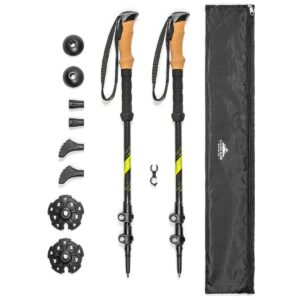
Around 7.8 ounces each. I carried these on the Grays and Torreys Peak 14er in Colorado (8.1 miles, 3,602 feet of gain) and the weight savings were real. My arms felt fresher above treeline. Cork grips and a full accessory kit keep the value high. The quick-lock system works well, though I double-check tightness before steep descents. Tips wear faster on rock than I’d like, so pack spares if you’re hitting sandstone country.
5. Black Diamond Trail Sport, Best All-Around Performance
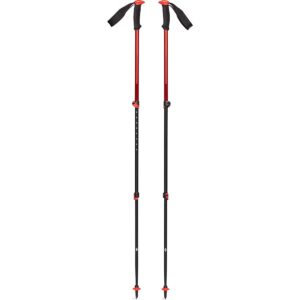
The FlickLock system is bombproof. It never slipped on me during the Fairyland Loop at Bryce Canyon (7.9 miles, 1,555 feet of gain) or the scree fields on Ben Lomond Peak near Ogden (14.9 miles, 3,618 feet of gain). EVA foam grips stay comfortable all day. At about 17 ounces each, they split the difference between ultralight carbon and heavy-duty aluminum. The straps could use more padding for long descents, but this is a pole that earns its reputation.
6. Foxelli Carbon Fiber Trekking Poles, Best Lightweight with Cork Grips
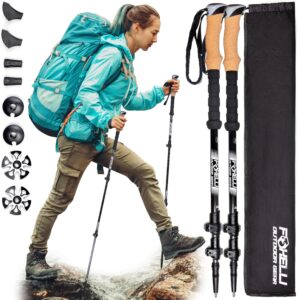
At 7.6 ounces each, these are among the lightest poles I’ve tested. The cork grips mold to your hands after a few hikes and the lever locks hold tight. I took these on the Bald Mountain Trail and the Lofty Lake Loop in the Uintas. They felt almost weightless on the uphills. Carbon fiber can crack with hard side impacts, so be mindful on tight slot canyon approaches. But for open alpine terrain and long ridge walks, they’re excellent.
7. Hiker Hunger Carbon Fiber Trekking Poles, Best for Big Mileage
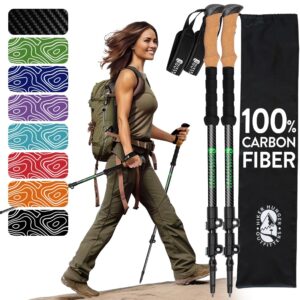
These are the poles I reach for on multi-day plans or big mileage days. I packed them for the Amethyst Lake Trail in the Uintas (13.0 miles, 2,326 feet of gain) and they performed all day. The extra foam grip below the cork handle is clutch for quick height changes on steep switchbacks. They collapse to 24 inches, which is not as compact as tri-fold designs, but the trade-off is rock-solid locking. If you’re pushing big miles in big mountains, these deliver.
8. TheFitLife Nordic Walking Poles, Best Budget with Anti-Shock
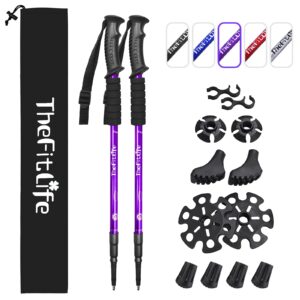
Budget pick. The anti-shock system actually works. I felt the difference on the rocky descent from Fortification Hill near Lake Mead (3.5 miles, 1,394 feet of gain). My knees were noticeably less beat up than on previous trips without shock absorption. Quick locks adjust from 26 to 51 inches without slipping. The foam grips are decent for the price, though the wrist straps start to chafe after about four hours. Check the basket threads regularly. They can loosen on rough trails. For the money, a solid entry point.
How Trekking Poles Actually Help Your Body
Trekking poles redistribute load from your legs to your arms, shoulders, and core. On a descent, they absorb impact that would otherwise go straight through your knees and ankles. On an ascent, they let you push with your upper body instead of relying entirely on your quads. The effect compounds over mileage. At mile two, poles feel optional. At mile eight, they feel essential.
For me, the rhythm matters as much as the mechanics. I’m on the spectrum, and repetitive physical patterns calm my nervous system. Plant, step, plant, step. It’s the same reason drumming works. The poles give my hands something purposeful to do, my breathing a structure to follow, and my brain a pattern to lock onto instead of spiraling into sensory overload on exposed terrain.
Carbon Fiber vs. Aluminum
Carbon fiber is lighter. Aluminum is tougher. That’s the core trade-off. On a long day like the Quandary Peak 14er (6.3 miles, 3,333 feet of gain), every ounce matters. Carbon fiber at 7 to 8 ounces each shaves real fatigue off a climb like that. But if you’re jamming poles between boulders on the Grandstaff Trail near Moab (5.7 miles, 836 feet of gain), aluminum bends where carbon snaps. Pick the material that matches your terrain.
Cork grips absorb sweat and mold to your hands over time. Foam dries fast and feels light. Rubber handles cold well but gets slippery when wet. I prefer cork for summer desert hiking and foam for alpine shoulder-season trips. If you’re grinding out an 8.6-mile push to Sky Pond in Rocky Mountain National Park (1,771 feet of gain), your grip material is the difference between comfort and blisters.
FAQ
Do trekking poles actually make a difference?
Yes. They reduce impact on knees and joints during descents, improve balance on uneven terrain, and distribute effort across your upper body on climbs. The effect is most noticeable on longer hikes and steep elevation changes. On a flat, groomed trail they’re less critical. On anything technical or sustained, they earn their weight immediately.
Should I get adjustable or fixed-length poles?
Adjustable. Fixed-length poles are lighter and slightly stronger, but adjustable poles adapt to varying terrain, pack down for travel, and work for different users. If you hike varied terrain or travel with your gear, adjustable is the practical choice.
Flip locks or twist locks?
Flip locks. They adjust faster, hold more reliably under pressure, and work with cold or gloved hands. Twist locks can seize, slip, or require two hands to adjust. Every pole on this list uses a flip or lever lock for that reason.
Your Knees Are the Gear You Can’t Replace
Bad knees compound. One hard descent without poles affects the next day’s hike, the next trip, the next year of trail access. Trekking poles are a simple, relatively cheap intervention that protects the joints you need for every future mile. I’ve hiked hundreds of miles across the American West as a solo adventurer on the autism spectrum. Every one of those miles taught me something about what gear actually matters. Trekking poles matter.
The cost of a $35 pair of Cascade Mountain Techs is less than one physical therapy co-pay. Start there. Scale up if the results justify it.
Support the Adventure
To make your walls less boring, check out my photography portfolio and bring a piece of the wild and my story into your home.
If you’d like to fuel future adventures, you can donate a coffee on Ko-Fi. Every cup keeps me chasing sunrises and stories.
When you shop using my affiliate links, every click helps support this blog at no extra cost to you. It’s a small way to keep Unicorn Adventure alive and kicking while I keep exploring.
Subscribe to my mailing list for future updates, new stories, and behind-the-scenes adventures.
Stay connected with me on Instagram and Facebook for more photos and daily inspiration.
Thanks for being part of the journey, Unicorn Squadron!

Theo Maynard is a landscape photographer and adventure blogger based in Salt Lake City. He chases remote desert and mountain light across the American West, documents it all solo, and shares the journey through Unicorn Adventure. He’s on the autism spectrum, and that’s not a footnote, it’s the whole story. He creates to inspire others to get outside, chase what lights them up, and live their best possible life. Unapologetically himself.