


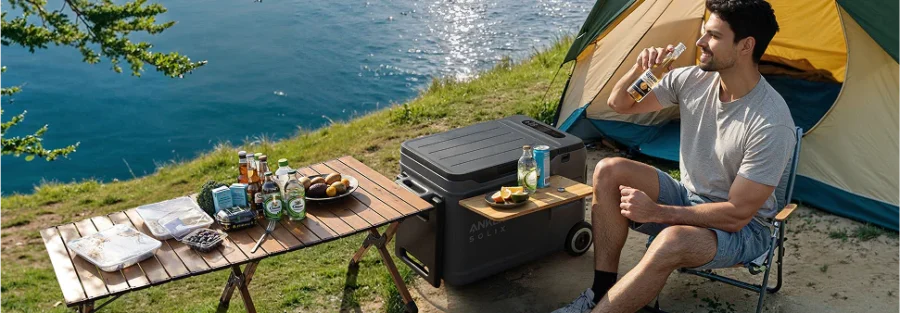
Best Portable Camping Fridge for Overlanding and Off-Grid Adventure
When I’m camped at Muley Point above the Goosenecks of the San Juan River or parked on a dispersed site along Valley of the Gods Road, the nearest town with a gas station is not close. The nearest town with a gas station that also sells ice is even further. On a June day in southern Utah, ambient temps inside a vehicle can push 120 degrees. Ice lasts maybe 18 hours in those conditions. Maybe.
I stopped running coolers two years ago. The switch to a compressor fridge changed how I plan trips, how long I stay out, and what I eat in the field. No more daily ice runs. No more opening a lid to find that my produce is floating. No more soggy everything. I load Estes in Salt Lake City, drive to wherever I’m going, and eat real food for as many days as I want.
This post covers the best portable camping fridges on the market, what makes each one worth considering, and the practical questions that matter for overlanding and multi-day desert camping specifically. Not van life on Instagram. Actual remote terrain, actual heat, actual long drives between resupply.
The Best Portable Camping Fridges, Ranked
1. ICECO VL35ProS, Best All-Around Overlanding Fridge
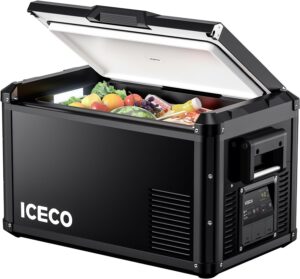
The ICECO VL35ProS is the fridge I’d put in most overlanding rigs. 35 liters, 12V/24V DC and 110-240V AC compatible, Secop compressor with a 5-year warranty, and a cooling range from 0°F to 50°F. Run it as a fridge or a freezer depending on what the trip calls for.
The multi-directional lid is the feature that earns it a spot in a vehicle-based setup. I can open it from either side or remove it entirely. That matters when cargo space is tight and the fridge is wedged into a specific corner of the cargo area. Forcing a fixed-lid fridge into the wrong position makes daily use annoying. This one adapts.
Max/Eco power modes let me choose between fast cooling after a warm load or battery-conserving steady state once temperature is reached. The built-in USB port charges a phone or headlamp without routing a cable to the power station. Steel case. Compact footprint. This is the benchmark.
2. ICECO VL75ProD, Best Dual-Zone for Extended Trips
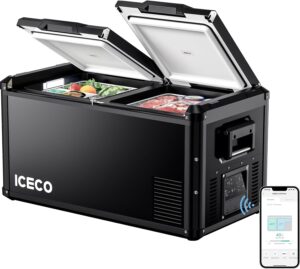
The ICECO VL75ProD is the step up for trips that run a week or longer. 75 liters, dual-zone, independent temperature control for each compartment. Run one side at fridge temp for produce and drinks while the other freezes meat. Temperature range is 0°F to 50°F across both zones.
The metal construction is noticeably more solid than budget plastic units. Reversible lids, power ports on both ends for flexible vehicle positioning, and the same Secop compressor platform as the VL35ProS with the same 5-year warranty. For a week-long push into Grand Staircase-Escalante, camping at Cedar Point, South Turkey, or Spencer Flat with no resupply, the 75-liter capacity justifies the footprint.
This is a two-person lift when loaded. Know that before you buy it. Budget accordingly for the cargo area space it occupies.
3. BougeRV E-Series, Best Budget Entry Point
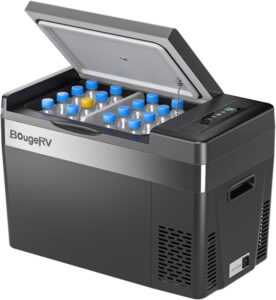
The BougeRV E-Series is the honest budget recommendation. 12V/24V DC and 110V AC compatible, compressor-based cooling, available in multiple sizes starting at 30 quarts. The 30-quart is right for weekend trips. The larger sizes handle longer runs.
It’s not built to the same spec as the ICECO or ARB units. The 2-year warranty versus the ICECO’s 5-year Secop warranty reflects that. But for someone who wants to stop buying ice on trips to Kodachrome Basin or overnight camps in Snow Canyon State Park and doesn’t want to spend $600 to do it, the BougeRV performs. Steady temperature, no ice logistics, real food on real trips.
Start here if you’re new to compressor fridges and want to prove the concept before investing in a premium unit.
4. EUHOMY 12 Volt Refrigerator, Best for Quiet Operation
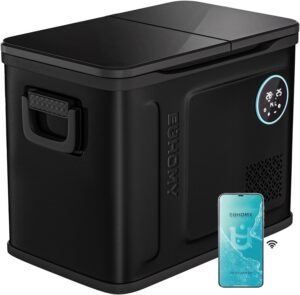
The EUHOMY 12 Volt Refrigerator comes in 37QT, 48QT, and 58QT sizes. Dual-zone storage, aluminum-lined compressor, 12/24V DC or 110-240V AC compatible, temperature range from -4°F to 68°F. Smart battery protection prevents vehicle battery drain.
The quiet operation is what distinguishes it. Compressor fridges make noise. The EUHOMY is noticeably quieter than most at its price point, which matters if the fridge sits inside the cab or close to a sleeping area. The 37QT model includes wheels and two internal baskets for organization. The 2-year warranty is shorter than the ICECO but the price is competitive.
Good option for campers who want dual-zone capability without paying Dometic prices and who prioritize a quiet camp environment. Worth considering for tent camping where the fridge sits close to where you sleep.
5. Manastin 37QT, Best Simple Single-Zone Option
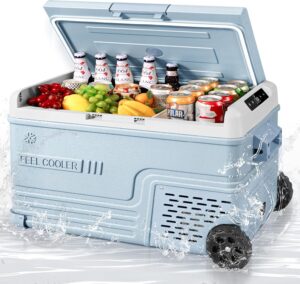
The Manastin 37QT portable car fridge is straightforward. 35 liters, 12/24V DC and 110-240V AC, temperature down to -4°F, built-in wheels, LED interior light, removable baskets and a shelf.
No dual zone, no app control, no advanced compressor warranty. Just a reliable single-zone compressor fridge with wheels and an honest price. The wheels are worth more than they sound. Moving a loaded fridge across a parking lot or a campsite without wheels is genuinely unpleasant. For a solo overlander doing weekend runs to places like Goblin Valley, the San Rafael Swell, or the Capitol Reef area, the Manastin covers the basics without overcomplicating the decision.
6. Dometic CFX3 Dual Zone, Best Premium Build
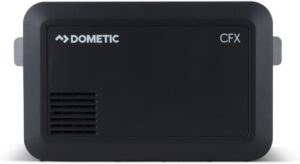
The Dometic CFX3 Dual Zone is the standard that other overlanding fridges get compared to. The 75DZ model offers 75 liters with fully independent dual-zone temperature control, down to -7°F. App control from a phone. Advanced compressor with noise and vibration reduction. AC, DC, and solar power compatible.
The lightweight fender frame and aluminum alloy handles are built to survive what overlanding actually looks like: rough roads, vehicle vibration, uneven terrain, being loaded and unloaded repeatedly. This fridge is designed for the long haul. Dometic has been building expedition-grade refrigeration since before most of the brands on this list existed.
The price reflects all of that. This is the unit for people who take extended overlanding trips seriously and want gear that outlasts everything else in the rig. If you’re doing multi-day OHV runs through Monument Valley, the Burr Trail, or any serious backcountry route and you want a fridge that keeps pace without asking for attention, the Dometic CFX3 is the benchmark.
7. Whynter FM-45G, Best Value True Freezer
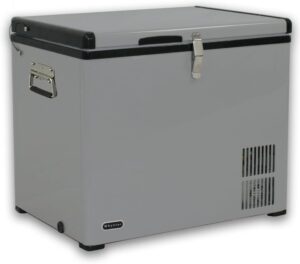
The Whynter FM-45G is a genuine freezer and refrigerator. 45 quarts, cooling range -8°F to 50°F, fast freeze mode, AC and DC compatible. At a fraction of what the Dometic costs, it delivers real freezer capability that cheap 12V coolers can’t touch.
The value equation here is strong. If you primarily need a freezer for meat on multi-day trips and don’t need dual-zone or premium build quality, the Whynter does the job cleanly. The insulation is solid and the temperature control is accurate. For campers who want to freeze food at home and keep it frozen through a five-day desert trip, this is the pick.
8. Alpicool C20, Best Compact Pick for Smaller Rigs
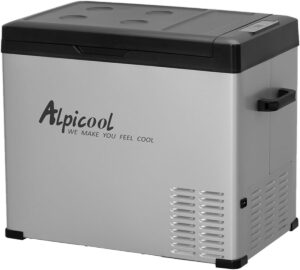
The Alpicool C20 holds 19.8 liters, about 21 quarts or 25 cans. 12V and 24V DC power, cooling down to -4°F, app-controlled temperature. Compressor-based. No ice needed.
This is for rigs where space is the primary constraint. A solo traveler in a smaller SUV, a motorcycle tourer, or anyone who needs a fridge but can’t sacrifice significant cargo space. The C20 fits in tight spots that larger units won’t touch. It’s not built for a week-long trip with serious food volume, but for a solo overnighter or a two-day run, it covers the essentials cleanly.
9. ARB 50 Quart Fridge Freezer, Best Off-Road Pedigree
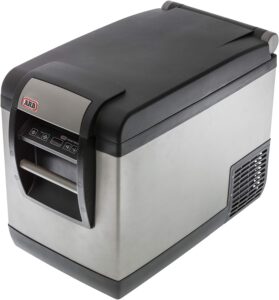
The ARB 50 Quart Fridge Freezer has been in overlanding rigs for decades. 50 quarts, true refrigerator and freezer capability, compressor-based, 12V and 110V compatible. The Classic Series II features a backlit touchpad that dims for night use and an electronic control system built to handle vehicle vibration and rough terrain.
The ARB reputation is built on years of actual field use, not just specs. Serious off-road community trust for this unit specifically because it performs consistently in the conditions that matter: extreme heat, rough roads, extended runs far from any service. The price is high. The build quality justifies it for anyone who does real overlanding rather than well-graded forest roads.
Holds 72 standard 12-ounce cans when used as a cooler equivalent. That’s real capacity for a group trip or a long solo run into deep backcountry.
Why a Compressor Fridge Changes the Way You Camp
The Ice Problem Is Real
A standard 50-quart cooler stuffed with ice holds maybe 30 usable quarts of food and drink space. The rest is ice. On a hot day in Death Valley or the Escalante Desert, that ice is gone within 18 to 24 hours. You need more ice. The nearest place with ice might be an hour’s drive each way. You’ve now spent two hours of your trip on an ice run, and you haven’t even hit the trailhead yet.
A compressor fridge eliminates that entirely. Every quart is usable space. The temperature is consistent regardless of ambient heat. There is no ice run. There is no soggy food. There is no decision between keeping things cold and driving to a trail.
Trip Length Is No Longer Limited by Ice Logistics
When I planned multi-day trips before making the switch, ice was a scheduling constraint. How many days before I need a resupply? Where’s the nearest gas station? Can I stretch it to four days or do I need to plan a loop that passes through town on day three?
None of those questions exist anymore. I can run Burr Trail, spend a night at Cedar Point, push through to Spencer Flat, and drive out five or six days later with the same food quality I had on day one. That freedom is the real value of a compressor fridge. It’s not a luxury. For the kind of remote overlanding I do through Grand Staircase, the San Rafael Swell OHV routes, and Monument Valley, it’s a logistics upgrade that makes longer and more remote trips possible.
Power Is a Solved Problem
The common objection to compressor fridges is power consumption. The answer is a portable power station paired with solar input, which is the setup I run with Estes anyway. Most compressor fridges draw 45 to 60 watts when actively cooling and cycle on and off to maintain temperature. On a 500Wh power station with even modest solar input, a mid-size fridge runs for days without depleting the battery. Pair a 1000Wh station with 200W of solar and you have essentially unlimited run time in the desert Southwest where the sun is a reliable resource.
The fridge and the power station are the same system. Each one makes the other more useful.
What to Look for When Buying a Portable Camping Fridge
Compressor Type and Warranty
The compressor is the most important component. Secop and Danfoss compressors are the gold standard and appear in the premium units on this list. They’re efficient, quiet relative to cheaper alternatives, and built for continuous operation in variable temperature environments. A 5-year compressor warranty is the indicator to look for. A 2-year warranty is acceptable at lower price points. Anything less is a warning sign.
Capacity and Footprint
Measure your cargo area before selecting a fridge. Not just length and width but the actual usable rectangle accounting for wheel wells, dividers, and gear you can’t move. For solo overlanding, 35 to 40 liters covers most trip lengths cleanly. For group trips or extended solo runs over a week, 50 to 75 liters gives you real food storage without rationing. Bigger is not always better. A 75-liter fridge that blocks your recovery gear access is worse than a 35-liter fridge that fits cleanly.
Dual Zone vs. Single Zone
Dual zone matters if you want to freeze meat while keeping produce and drinks at fridge temperature simultaneously. Single zone is simpler, usually more affordable, and perfectly adequate if you’re willing to pre-freeze food and keep it frozen rather than doing active freezing in the field. For most overlanders on trips up to a week, single zone at fridge temperature handles the job. For extended trips where you want fresh-frozen protein, dual zone earns its cost.
Power Input Options
12V DC is the baseline. Every unit here supports it. 24V support matters for larger diesel vehicles and some commercial rigs. AC compatibility lets the fridge pull from shore power at a campground or a household outlet at home, which is useful for pre-cooling before a trip. App control and solar compatibility are nice additions but not essential. The fridge needs to keep food cold. Everything else is convenience layered on top.
Lid Design and Access
Fixed-lid fridges with a single opening direction are fine until the fridge is wedged into your cargo area in the one position where the lid opens into a wall. Multi-directional or reversible lids eliminate that problem entirely. This is a small feature that becomes a genuine daily frustration if you get it wrong. Check lid direction before buying.
How to Run a Compressor Fridge on a Multi-Day Trip
Pre-Cool Before Loading
Run the fridge for 30 to 60 minutes before packing food into it. Loading warm food into a warm fridge forces the compressor to work hard for an extended period to bring everything down to temperature. Pre-cooling means the fridge is already at set temperature when food goes in, the compressor runs a normal cycle, and battery draw stays manageable from the start.
Keep It Full
A partially full fridge loses temperature faster every time you open the lid because warm air replaces the cold air. Fill gaps with water bottles. They maintain thermal mass, hold temperature longer after opening, and give you backup drinking water. A full fridge is a more efficient fridge.
Minimize Lid Opens
Decide what you need before you open the lid. One trip to the fridge per meal rather than multiple open-and-search sessions. This is a discipline thing, not a hardware thing. It makes a meaningful difference in power consumption over a multi-day trip.
Battery Protection Settings
Every serious compressor fridge has a battery protection mode that shuts the unit down before it drains the vehicle battery below safe starting voltage. Set it. On most units, low, medium, and high protection levels correspond to 11.6V, 11.8V, and 12.0V cutoffs. If you’re running a dedicated auxiliary battery or a portable power station, this matters less. If you’re running directly off the vehicle battery, set the protection level and don’t bypass it.
Frequently Asked Questions
How long will a compressor fridge run on a portable power station?
A mid-size fridge drawing 45 to 55 watts of average consumption will run approximately 8 to 12 hours on a 500Wh station, 15 to 22 hours on a 1000Wh station. Add solar input and those numbers extend significantly. In the desert Southwest with consistent summer sun and 200W of solar panels, a 1000Wh station paired with a mid-size fridge runs essentially indefinitely during daylight hours with adequate overnight reserve.
Will a compressor fridge drain my vehicle battery?
If you’re running directly off the vehicle’s starting battery with the engine off, yes, over time. Most compressor fridges have battery protection settings that cut power before the battery drops below safe starting voltage. The better long-term solution is a dedicated auxiliary battery or a portable power station as the fridge’s power source. Never run a compressor fridge off your starting battery overnight without protection settings engaged.
What size fridge do I need for a solo camping?
For trips up to four days, 20 to 35 liters covers a solo camper eating real meals. For week-long trips or trips where you’re carrying more than just personal food, 35 to 50 liters is the range. The ICECO VL35ProS at 35 liters is a clean fit for most solo scenarios. Go up to the 50-quart range only if you’re cooking for more than one person or running trip durations over seven days.
Can I run a compressor fridge on solar alone?
Yes, with adequate panel wattage and a battery buffer. A 200W solar setup feeding a 500Wh or larger battery handles a mid-size compressor fridge in most summer conditions in the American West. The battery handles overnight load. The solar recharges during the day. This is the setup I run on extended Estes trips and it works cleanly in the desert environments where I spend most of my time.
What’s the difference between a compressor fridge and a 12V thermoelectric cooler?
A compressor fridge uses the same technology as your household refrigerator and can cool to genuine fridge and freezer temperatures regardless of ambient heat. A thermoelectric cooler uses a Peltier device that can only cool about 40 degrees below ambient temperature, meaning on a 100-degree day it can only reach about 60 degrees, which is not food-safe. For any serious camping use, always buy a compressor fridge. Thermoelectric coolers are not adequate for food safety in summer conditions.
The Best Portable Camping Fridge Is the One That Gets You Out Longer
I’ve camped at Gemini Bridges, parked on the rim above Muley Point, run the Valley of the Gods Road at sunrise, and spent nights at spots with no address on any map. Every one of those trips was better because I wasn’t thinking about ice. I was thinking about the light, the terrain, and where I wanted to be at dawn.
The best portable camping fridge for overlanding is the one that disappears from your logistics entirely. You load it in Salt Lake City, you drive wherever Estes takes you, and you eat well the whole time. For most solo overlanders, that’s the ICECO VL35ProS. For longer or group trips, step up to the VL75ProD or the Dometic CFX3. For budget entry, the BougeRV does the job.
Stop buying ice. Go further. Stay longer.
Support the Adventure
To make your walls less boring, check out my photography portfolio and bring a piece of the wild and my story into your home.
If you’d like to fuel future adventures, you can donate a coffee on Ko-Fi. Every cup keeps me chasing sunrises and stories.
When you shop using my affiliate links, every click helps support this blog at no extra cost to you. It’s a small way to keep Unicorn Adventure alive and kicking while I keep exploring.
Subscribe to my mailing list for future updates, new stories, and behind-the-scenes adventures.
Stay connected with me on Instagram and Facebook for more photos and daily inspiration.
Thanks for being part of the journey, Unicorn Squadron!

Theo Maynard is a landscape photographer and adventure blogger based in Salt Lake City. He chases remote desert and mountain light across the American West, documents it all solo, and shares the journey through Unicorn Adventure. He’s on the autism spectrum, and that’s not a footnote, it’s the whole story. He creates to inspire others to get outside, chase what lights them up, and live their best possible life. Unapologetically himself.