


Best Portable Jump Starter for Overlanding and Off-Grid Camping
I’ve been stranded exactly once. Not fully stranded, but close enough to feel it. I was parked on a two-track off Onion Creek Road outside Moab, deep enough that flagging someone down wasn’t a real option. Estes, my 4Runner, had sat in the cold overnight. Turned the key. Nothing. That moment changed what I keep in the truck.
A portable car battery jump starter isn’t exciting gear. It’s the thing you forget about until you desperately need it. But if you drive solo into remote canyons, up unmaintained forest roads, or deep into the San Rafael Swell on a multi-day OHV run, it’s not optional. It’s survival gear.
I researched and tested the best options on the market. Here’s what’s worth your money and what’s worth keeping in your rig.
Why Solo Campers Need a Jump Starter More Than Anyone
Most drivers have a safety net. They’re near other cars, near cell service, near help. I often am not. When I’m camped at Muley Point above the Goosenecks of the San Juan River, or parked at a dispersed site off the Valley of the Gods Road, the nearest human being might be miles away.
I’m also autistic. Unplanned situations hit differently when you’re wired the way I am. A dead battery in a remote canyon isn’t just an inconvenience. It’s a cascading disruption. Having a jump starter in the truck isn’t just preparedness. It’s the thing that keeps a bad situation from becoming a meltdown in the middle of nowhere.
It also means I never have to depend on a stranger. I can handle it myself. That matters to me more than I can fully explain.
The Best Portable Car Battery Jump Starters, Ranked
1. Hulkman Alpha85S, Best for Trucks and Cold Weather
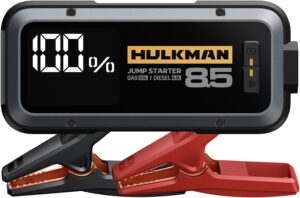
The Hulkman Alpha85S is the one I’d put in a truck going to cold, remote places. 2000 amps peak, 20000mAh capacity, handles gas engines up to 8.5 liters and diesel up to 6.0 liters. The Pre-Heat technology is the feature that stands out. It works down to -40 degrees F, which matters if you’re camping in southern Utah in January or pushing into higher elevation sites in early spring.
The 3.3-inch LED display shows charge level clearly. Ten layers of protection including spark-proof and reverse-polarity safeguards. The 65W fast charge means you can top it off quickly at a trailhead or resupply stop. For a heavy rig doing serious off-road, this is the unit to carry.
2. NOCO Boost X GBX45, Best Compact Lithium Option
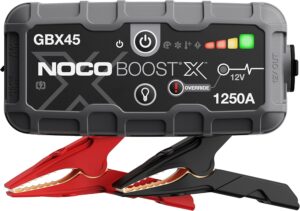
The NOCO Boost X GBX45 is a portable lithium jump starter that delivers 1,250 amps of power. I found this model works well for 12-volt batteries in vehicles with gas engines up to 6.5 liters and diesel engines up to 4.0 liters.
This jump starter handles cars, trucks, SUVs, motorcycles, boats, and RVs. The compact design makes it easy to store in my vehicle without taking up much space.
The GBX45 includes 60W USB-C Power Delivery, which means I can use it as a power bank for my devices. The lithium battery recharges quickly between uses.
I appreciate that this model provides up to 40 jump starts on a single charge. The UltraSafe technology protects against reverse polarity and sparks during connection.
The unit weighs less than traditional jump starters while maintaining strong performance. It comes with jumper cables built into the design for quick emergency use.
3. NOCO Boost Plus GB40, Best Everyday Carry
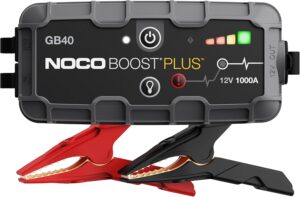
The NOCO Boost Plus GB40 is the no-fuss option for daily drivers who also head into the backcountry. 1000 amps, gas engines up to 6.0 liters, diesel up to 3.0 liters. Spark-proof clamps, reverse polarity protection, rubber casing that handles drops.
The manual override feature jumps completely dead batteries even when voltage is extremely low. That’s the edge case that matters most in the field. Up to 20 jump starts per charge, USB output for devices. It lives in the glove box of Estes when I’m not running one of the heavier units.
4. WOLFBOX 3000A, Best Multi-Tool Option
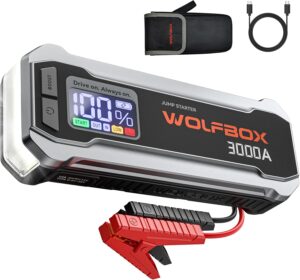
The WOLFBOX 3000A combines a jump starter with a built-in air compressor. 3000 amps peak, 16000mAh battery, 8.0 liter gas and 6.0 liter diesel capability. The compressor hits 160 PSI, enough for any truck or SUV tire.
The IP64 rating resists dust and water splashes, which matters when you’re crawling a technical OHV route like Hurrah Pass or running Mineral Bottom Road and kicking up serious grit. 65W USB-C fast charge. LED display. Ten safety protections. If you want one less piece of gear to pack, this is how you get there.
5. DBPOWER 800A, Best Budget Pick
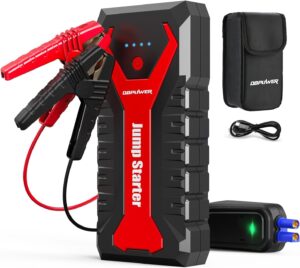
The DBPOWER 800A is the value option. 800 amps peak, 18000mAh, handles gas up to 7.2 liters and diesel up to 5.5 liters. LCD screen, LED flashlight, smart charging port, and a built-in compass.
Three-year warranty. Small enough for a glove box. If you’re just getting started with overlanding, or you want a backup unit alongside your primary jump starter, the DBPOWER covers the basics without a big investment.
6. Clore Automotive JNC660, Best Lead-Acid Option for Heavy Rigs
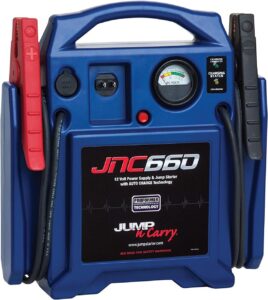
The Clore JNC660 is old-school in the best way. 1700 peak amps, 22Ah Clore PROformer lead-acid battery built specifically for jump starting. Heavy-duty cables, built-in voltmeter, rugged construction.
This is what automotive garages and towing operations reach for. Bulkier than a lithium unit, so it lives in the cargo area rather than the glove box. But if you run a heavy diesel truck or want serious cranking reserve for cold-weather starting, the lead-acid chemistry delivers sustained output that lithium units can’t always match.
7. Stanley J5C09, Best Budget Multi-Function Unit
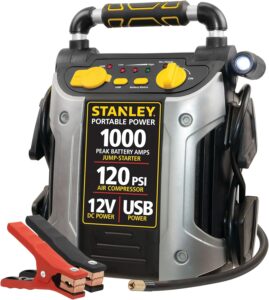
The Stanley J5C09 does more than jump start. 1000 peak amps, 120 PSI air compressor, 2.1A USB port, 12V outlet, reverse polarity protection. Works with AGM, GEL, and WET 12V batteries. Charges from a standard 120V household outlet.
It’s not the most powerful unit on this list. But if you want one affordable tool that handles a dead battery, a flat tire, and can charge your phone, the Stanley earns its spot. Keep it topped off every 30 days if it’s sitting in the truck. The backlit pressure gauge makes inflation straightforward, even at night.
How Portable Jump Starters Actually Work
A jump starter transfers energy from its internal battery to your dead car battery, providing enough current to turn the engine over and get the alternator running. Once the engine starts, the alternator takes over and recharges the car battery. The jump starter is out of the picture.
Modern lithium units are small because lithium-ion chemistry stores a lot of energy in a compact footprint. Lead-acid units are bigger but deliver sustained high current output that some heavy engines need. Ultracapacitor units charge nearly instantly and handle extreme cold, but don’t hold charge long when sitting unused.
For most overlanders running a gas or diesel SUV or truck, a lithium unit rated 1000 to 2000 amps covers every situation you’re likely to encounter.
What to Look for When Buying a Portable Jump Starter
Peak Amps and Cranking Amps
Peak amps is the maximum burst the unit delivers. Cranking amps is the sustained output. Small gas engines under 4.0L need 400 to 600 amps. Mid-size SUVs and trucks with 4.0 to 6.0L engines need 1000 to 2000 amps. Big diesel engines need 2000 amps or more. In cold temperatures, add 25 to 30 percent to those numbers. Batteries are weaker in the cold.
Battery Capacity
Capacity in milliamp-hours (mAh) tells you how many jump starts you get between charges. Aim for at least 12000 to 16000mAh for a unit that lives in the truck and sits unused between trips. A unit that can’t start your car because it self-discharged is just dead weight.
Safety Features
Reverse polarity protection and spark-proof clamps are non-negotiable. These prevent damage when you hook up the clamps wrong, which happens when you’re stressed, it’s dark, and you’ve been driving for eight hours. Overcharge and overtemperature protection matter too. Every unit on this list covers the basics.
Extra Features
USB charging ports let the jump starter double as an emergency power bank for phones and cameras. A built-in flashlight is genuinely useful in the dark. An air compressor is a real upgrade if you air down for off-road and need to air back up. IP dust and water ratings matter for rigs that go where the road ends.
How to Jump-Start Your Vehicle Safely
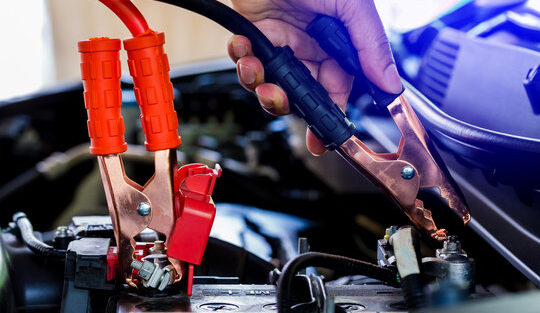
Turn off both the vehicle and the jump starter before connecting anything. Connect the red clamp to the positive terminal on the dead battery. Connect the black clamp to a metal ground on the engine block, away from the battery. Never clamp directly to the negative battery terminal.
Do not let the clamps touch each other once connected. Modern vehicles have sensitive electronics. A spark in the wrong place can damage more than just the battery.
Turn on the jump starter, then try to start the vehicle. Once the engine runs, remove the clamps in reverse order: black first, then red. Let the engine run for 15 to 30 minutes so the alternator partially recharges the battery.
If the engine doesn’t start after two or three attempts, stop. Repeated tries can overheat the jump starter and drain it fast. Wait two minutes between attempts.
Keeping Your Jump Starter Ready When It Counts
Lithium batteries degrade when stored fully charged or fully empty. Keep yours between 50 and 70 percent charge for long-term storage. Recharge it every three to six months even if you haven’t used it. Store it somewhere cool and dry. The cargo area of a truck in a Utah summer can hit temps that genuinely damage lithium cells.
Check the clamp cables before each use. Look for cracked insulation or loose connections. A jump starter with damaged cables is useless, or worse, dangerous. Keep the charging port covered when not in use.
If the unit won’t charge a dead battery, try the boost or override mode most modern units include for severely depleted batteries. If it still fails, the problem might be the vehicle’s starter motor or alternator, not the battery.
Frequently Asked Questions
What’s the best portable car battery jump starter for a 4Runner or similar SUV?
The NOCO Boost X GBX45 handles most 4Runner configurations cleanly. For older rigs or cold-climate use, step up to the Hulkman Alpha85S. Either one lives well in a truck that goes off-road.
How many amps do I need to jump-start a diesel truck?
At minimum 2000 peak amps for a diesel. Cold weather pushes that number higher. The Hulkman Alpha85S at 2000 amps and the WOLFBOX 3000A are the right picks for diesel engines on this list.
Can I use a jump starter to charge my phone or camera?
Yes. Every unit here except the Clore JNC660 includes USB output. The NOCO GBX45 includes 60W USB-C Power Delivery, which charges most modern phones and laptops at full speed.
How long does a jump starter hold its charge when sitting unused?
Lithium units hold charge for 6 to 12 months in good storage conditions. Recharge every three to six months to keep them ready. Lead-acid units like the Clore JNC660 lose charge faster and need more frequent top-offs.
Should I carry a jump starter even with a new battery?
Yes. Batteries fail without warning. I’ve had a battery go from fine to dead overnight in cold temperatures. No battery age protects you from that. The jump starter is cheap insurance against a situation where waiting for help is not an option.
The Best Portable Car Battery Jump Starter Is the One You Actually Have With You
I put Estes through real terrain. Onion Creek. Hurrah Pass. Valley of the Gods. Dispersed sites with no name on any map. I go alone most of the time. Being autistic and solo in remote places means I plan for the things that can go wrong, because I know what happens when I don’t.
A dead battery in a parking lot is annoying. A dead battery on a two-track in the middle of Bears Ears with no cell signal is a different situation entirely. The right portable car battery jump starter turns a crisis into a ten-minute fix.
Carry one. Keep it charged. Know how to use it before you need to.
Support the Adventure
To make your walls less boring, check out my photography portfolio and bring a piece of the wild and my story into your home.
If you’d like to fuel future adventures, you can donate a coffee on Ko-Fi. Every cup keeps me chasing sunrises and stories.
When you shop using my affiliate links, every click helps support this blog at no extra cost to you. It’s a small way to keep Unicorn Adventure alive and kicking while I keep exploring.
Subscribe to my mailing list for future updates, new stories, and behind-the-scenes adventures.
Stay connected with me on Instagram and Facebook for more photos and daily inspiration.
Thanks for being part of the journey, Unicorn Squadron!

Theo Maynard is a landscape photographer and adventure blogger based in Salt Lake City. He chases remote desert and mountain light across the American West, documents it all solo, and shares the journey through Unicorn Adventure. He’s on the autism spectrum, and that’s not a footnote, it’s the whole story. He creates to inspire others to get outside, chase what lights them up, and live their best possible life. Unapologetically himself.