


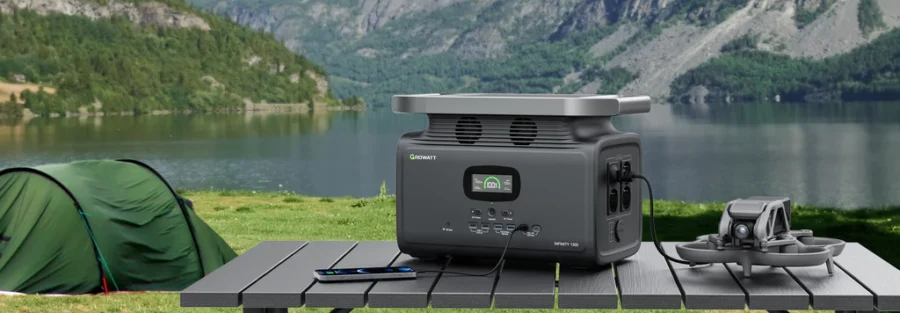
The Best Portable Power Station for Camping (Tested Across Utah’s Desert and Mountains)
I run a lot of gear in the field. Camera batteries, a drone, a laptop, sometimes a portable fridge loaded in the back of Estes, my 4Runner. I’ve camped at Gemini Bridges outside Moab, dispersed sites along Valley of the Gods Road in southern Utah, and base camps near the Uintas. None of those spots have outlets. Finding the best portable power station for camping wasn’t a product review exercise for me. It was a real need.
I’m also autistic. Routine and control matter to me. Knowing my gear is charged and ready before I head out is part of how I function well in the backcountry. A dead battery at sunset, when I’m trying to shoot golden light over Fisher Towers or the White Rim, isn’t a minor inconvenience. It derails the whole purpose of the trip.
This post breaks down the power stations I’ve researched and tested, what actually matters when you’re buying one, and how to match a unit to the kind of camping you actually do.
Why Portable Power Matters for Off-Grid Camping
Most of my camping isn’t at a developed site with hookups. It’s a pulloff on Burr Trail, a dispersed site in Grand Staircase-Escalante, a ridge somewhere in the Uintas with no trail name on the map. Out there, power isn’t a luxury. It’s logistics.
A good camping power station lets me shoot all day, recharge overnight, and do it again. It means I can use a CPAP if I need one, keep a headlamp charged, or run a small fan when summer desert temps stay brutal after dark. Solar input makes all of that sustainable across multiple days without driving back to civilization.
Nature has always been where my brain resets. That’s not a metaphor. For me, the stillness of a canyon at first light or a high alpine lake in the Uintas genuinely quiets the noise. Staying out longer, and doing it comfortably, requires the right gear. Power is part of that equation.
The Best Portable Power Stations for Camping, Ranked
1. Anker SOLIX C1000, Best All-Around Pick
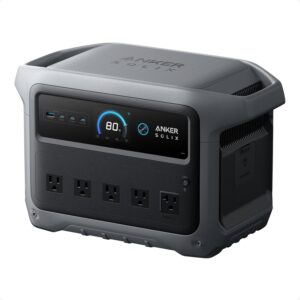
The Anker SOLIX C1000 is what I’d recommend to most campers. 1056Wh of capacity, 1800W output, and a LiFePO4 battery that doesn’t degrade fast. It handles cameras, laptops, a mini-fridge, and USB charging simultaneously without complaining.
The app-based energy monitoring is genuinely useful. I can check draw in real time without digging through menus. Ultra-fast charging means I can top it off during a resupply stop and be back out on the road. It’s not light, but for the capacity it holds, the weight is fair.
For a multi-day trip out to something like Coyote Gulch in Grand Staircase-Escalante, this is the unit I’d want in the back of Estes.
2. Jackery Explorer 1000 v2, Best for Weekend Campers
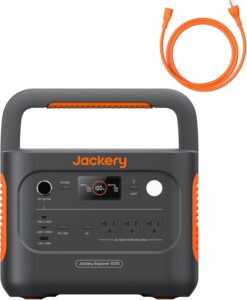
The Jackery Explorer 1000 v2 packs 1070Wh with 1500W output. LiFePO4 battery, roughly one-hour charge time, and a solid mix of ports including a 100W USB-C. It’s lighter than the original while keeping the same power output.
If you’re doing weekend trips, car camping, or headed somewhere like Kodachrome Basin or the campsite I love near Gemini Bridges outside Moab, this unit is a clean fit. Solar compatible, no fumes, no noise. Works inside a tent if the temps are cold and you need to keep gear warm and charged.
The price is mid-range. For what you get, it earns it.
3. Jackery Explorer 300, Best Lightweight Option
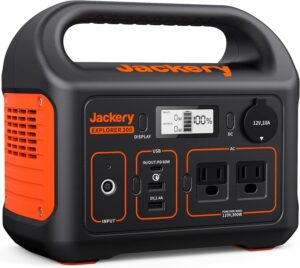
The Jackery Explorer 300 is 7 pounds. That’s it. 293Wh, 300W pure sine wave output, and solar-compatible via Jackery’s SolarSaga panels. For overnight or two-night trips where I’m keeping it light, this handles phones, a camera, and a small light without any drama.
It’s also a great first power station if you’re new to off-grid camping. Low barrier to entry, simple interface, does what it says. Toss it in the back of a car or strap it to the passenger floor of Estes on shorter runs to places like Snow Canyon State Park or an Antelope Island overnight.
4. EcoFlow Delta Pro, Best for Base Camp Power
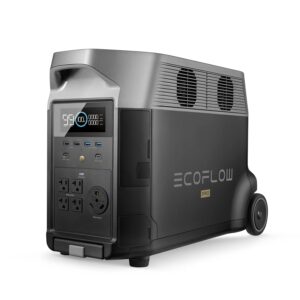
The EcoFlow Delta Pro is a different beast. 3600Wh standard, expandable to 25kWh with add-ons. 3600W continuous, 7200W surge. It runs fridges, air conditioners, medical equipment.
At 99 pounds, it’s not going anywhere without wheels. This is a base camp unit or an RV unit. Not something you hike in. But if you’re setting up a serious multi-day camp, pulling a trailer, or using it as home backup during a winter storm, it delivers.
The app interface is clean. LiFePO4 battery chemistry means long cycle life. If your camping style involves staying put and powering a lot of gear, this is the one.
5. EcoFlow RIVER 2 Max, Best Mid-Size Value
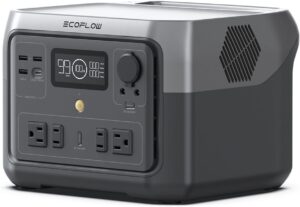
The EcoFlow RIVER 2 Max hits a sweet spot. 512Wh, 1000W output, 13.3 pounds. Charges from a wall outlet in about 60 minutes and accepts up to 220W solar input.
The LFP battery is rated for 3000+ charge cycles. Five-year warranty. At this price point with those specs, it’s one of the better values in the mid-size category. Good for weekend camping, longer road trips with a resupply strategy, or emergency home backup. Comes ready to use out of the box.
6. Bluetti AC200PL, Best High-Capacity Solar Station
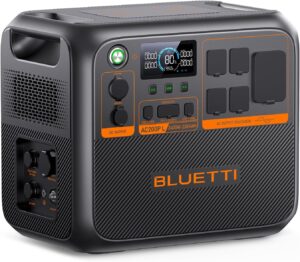
The Bluetti AC200PL is for serious off-grid setups. 2300Wh storage, 2000W continuous output, 700W solar input. LiFePO4 cells rated 3500+ cycles.
That solar input rating is what makes it stand out. I can run gear during the day off solar while simultaneously recharging the unit. On a long desert trip, like pushing through Monument Valley or camping somewhere along the San Rafael Swell OHV routes, that cycle matters.
It’s 70 pounds. Use the handles. Worth the weight if you’re doing extended off-grid work.
7. Pecron E2000LFP, Best for Long Off-Grid Stays
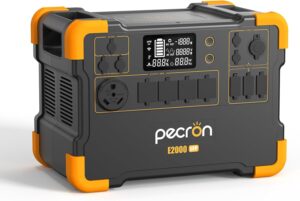
The Pecron E2000LFP pushes 2000W continuous with 4000W surge capability. 1920Wh base capacity, expandable to 8064Wh. Pure sine wave inverter. LiFePO4 chemistry.
This is a heavy unit built for extended base camp or RV use. It runs fridges, cooking gear, and lights without issue. The expandability is what makes it interesting for serious off-grid situations. Not the most well-known brand, but the specs are real and the build holds up.
What to Actually Look for in an Off-Grid Power Station
Battery Capacity and Output
Capacity is measured in watt-hours (Wh). A 500Wh unit runs a 50W device for about 10 hours. Your phone pulls 10-20Wh per charge. A laptop uses 50-100Wh. A portable fridge draws 40-60W continuously, which adds up to over 1000Wh in 24 hours. Do the math before you buy.
Output wattage tells you what you can actually run at once. A 1000W output station handles small appliances, not all of them simultaneously. Always check the continuous output number, not just the surge rating.
Ports matter. AC outlets, USB-A, USB-C, and 12V car port are the basics. More ports mean fewer adapters and less fighting over who charges next.
Portability and Weight
Under 10 pounds works for hiking and backpacking. 20-30 pounds is the car camping range. Anything heavier is a base camp or vehicle unit. I match the size to the trip, not the other way around. There’s no reason to haul a 70-pound station to a trailhead.
Handle quality and case corners matter for real outdoor use. If it’s going in and out of Estes’s cargo area every trip, it needs to take some abuse.
Solar Compatibility
If you’re camping beyond two days, solar input matters. Check the maximum solar wattage the station accepts. A unit that takes 200W of solar charges much faster than one capped at 60W. Also check whether it uses MC4 connectors or proprietary ones. MC4 gives you more panel options down the road.
A 1000Wh station with 200W of solar needs roughly five to six hours of decent sun for a full charge. That’s doable on most summer days in southern Utah, which is where I spend a lot of my time.
Safety Features That Actually Matter
A solid Battery Management System (BMS) protects against overcharge, overheating, and shorts. LiFePO4 chemistry is inherently safer than standard lithium-ion and handles temperature extremes better. Check for certifications, not just marketing copy.
Pure sine wave inverters matter for sensitive electronics. If you’re powering a CPAP, a camera battery charger, or a laptop, a modified sine wave inverter can cause problems over time. All of the units on this list use pure sine wave.
How to Choose the Right Camping Power Station for Your Setup
Start with your actual power needs. List every device you plan to charge and its watt draw. Multiply by hours of use. That’s your daily watt-hour target. Add 20% buffer for inefficiencies.
Then factor in trip length. Weekend trips with basic devices, go with the Jackery 300 or RIVER 2 Max. Three-to-five day desert trips with camera gear and a fridge, look at the Anker C1000 or Jackery 1000 v2. Extended off-grid stays or RV camping, step up to the Bluetti AC200PL, Delta Pro, or Pecron E2000LFP.
Match the unit to how you actually camp. I spend time at places like the Goblin Valley area near Torrey, dispersed spots outside Capitol Reef, and campsites along the OHV routes in the San Rafael Swell. None of those require a 100-pound power beast. The Anker C1000 handles everything I need without maxing out Estes’s payload.
Frequently Asked Questions
What’s the best portable power station for most campers?
The Anker SOLIX C1000. It covers most camping use cases, charges fast, and the app monitoring is genuinely useful. The Jackery Explorer 1000 v2 is a close second with slightly lighter weight.
Which power station is best for home backup?
The EcoFlow Delta Pro. High continuous wattage, expandable capacity, fast recharge. It handles fridges, medical devices, and essential appliances during outages.
What’s the lightest option for casual camping?
The Jackery Explorer 300 at just over 7 pounds. Handles phones, cameras, and small devices. Easy to carry, solar-compatible, and simple to use.
Do I really need solar panels with a power station?
For trips longer than two or three days, yes. Without solar, you’re limited to what the battery holds when you leave the car. With solar, you can extend a trip indefinitely if the sun cooperates. In the desert Southwest, it usually does.
Can I use a power station with a CPAP machine?
Yes, as long as the station has a pure sine wave inverter, which all of the units listed here do. Check your CPAP’s watt draw and calculate how many nights you can run it per charge.
The Best Portable Power Station for Camping Is the One That Keeps You Out Longer
I didn’t get into overlanding and backcountry photography to spend my trips worrying about battery levels. Power is a tool. When it works, you stop thinking about it and start doing the thing you actually came to do.
Being autistic, and navigating the world in a way that’s different from most people, taught me to be deliberate about the tools I choose. The wrong gear creates friction. The right gear disappears. The best portable power station for camping does exactly that. It disappears into the background while you’re standing at the edge of a canyon watching the light change.
That’s what I’m after. Fewer obstacles between me and the wild places. These power stations, matched to the right trip, get me there.
Support the Adventure
To make your walls less boring, check out my photography portfolio and bring a piece of the wild and my story into your home.
If you’d like to fuel future adventures, you can donate a coffee on Ko-Fi. Every cup keeps me chasing sunrises and stories.
When you shop using my affiliate links, every click helps support this blog at no extra cost to you. It’s a small way to keep Unicorn Adventure alive and kicking while I keep exploring.
Subscribe to my mailing list for future updates, new stories, and behind-the-scenes adventures.
Stay connected with me on Instagram and Facebook for more photos and daily inspiration.
Thanks for being part of the journey, Unicorn Squadron!

Theo Maynard is a landscape photographer and adventure blogger based in Salt Lake City. He chases remote desert and mountain light across the American West, documents it all solo, and shares the journey through Unicorn Adventure. He’s on the autism spectrum, and that’s not a footnote, it’s the whole story. He creates to inspire others to get outside, chase what lights them up, and live their best possible life. Unapologetically himself.