

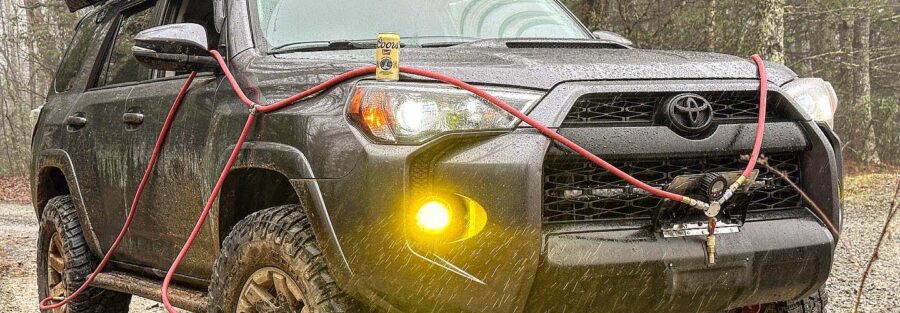
Best Off-Road Air Compressor for 4×4 and Trail Use
Tire pressure is one of the most overlooked tools in your overland kit. Air down for the trail and you get traction. Air back up for the highway and you protect your tires and your gas mileage. That swing between those two states is where a good portable air compressor earns its keep.
I run a Toyota 4Runner named Estes. We’ve been into Grand Staircase, Bears Ears, the Uintas, Moab, and deep into mountain backcountry. Out there, you’re not always close to a gas station, let alone a shop with a compressor. That’s why a trail-capable unit lives in my rig at all times.
Here’s what I’ve tested and what I actually trust.
What to Look For First
Before we get into the list, here’s what actually matters when you’re shopping.
CFM. Cubic feet per minute is how fast the compressor moves air. If you’re running 35s or bigger, you want at least 2.5 CFM. Less than that and you’re standing around on the trail while the compressor huffs and puffs.
Max PSI. You need at least 150 PSI for most truck tires. That covers you from a deep air-down back up to highway pressure.
Duty cycle. This tells you how long it can run before it needs a break. A 50% duty cycle at 100 PSI means it runs for 5 minutes, rests for 5. The higher the duty cycle, the more tires you can handle in a session.
Power source. Most trail compressors run off 12V and clip straight to your battery. Skip the cigarette lighter socket. For high-draw units, it’ll choke the output and trip fuses.
Build quality. Metal housings survive abuse. Plastic ones don’t. If you’re putting a compressor in the dirt next to a muddy tire, build quality matters.
The Best Off-Road Air Compressors
1. MORRFlate TenSix PSI Pro Gen2, Best High-Performance Portable
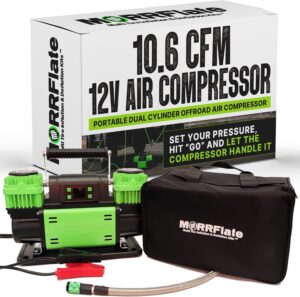
This is the one I recommend most. The dual-cylinder design pushes 10.6 CFM at 0 PSI and 6.5 CFM at 30 PSI. With a four-tire hose kit, you can go from 10 PSI to 40 PSI across a set of 35s in under five minutes.
The PSI Pro Technology handles the stopping for you. Set your target pressure, hit go, and it shuts off automatically. No babysitting. No over-inflation.
It runs on 12V and draws about 50 amps during normal operation. The 80% duty cycle at 0 PSI means it can run for 45 minutes before it needs a 10-minute break. I can usually air up six to eight rigs before it asks for a rest.
Comes in a carry bag, 14 x 7 x 9 inches. Solid trail kit.
2. Viair 400P, Best All-Around Trail Compressor
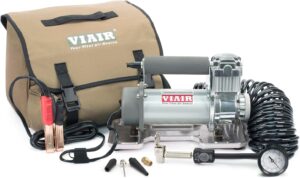
The 400P is a strong, proven trail compressor. It handles tires up to 35 inches and inflates a 35-inch tire from 0 to 30 PSI in under six minutes.
Oil-less design with a PTFE piston gear. Moisture and dust-resistant housing. The automatic thermal overload protector keeps it from cooking itself during longer sessions.
One-hour run time before it needs to cool off. Includes a 5-in-1 inflator/deflator tool and a 100 PSI gauge. Everything packs into a dual-compartment carry bag.
Reliable, well-built, and it’s been around long enough to prove itself. Hard to go wrong with the 400P.
3. Viair 300P, Best for Smaller Tires and Budget Builds
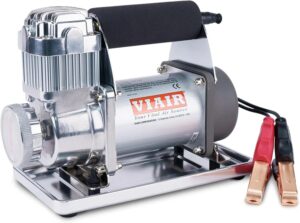
The 300P is the 400P’s lighter sibling. It’s rated for tires up to 33 inches and maxes out at 150 PSI. Clamps straight to your battery, draws 30 amps or less.
The 33% duty cycle at 100 PSI means it needs more breaks than the 400P, so plan accordingly if you’re airing up a whole group. But for solo use on a smaller rig, it does the job.
Sits on an aluminum tray with vibration isolators, which I appreciate. Includes a 25-foot hose and three inflation tips. IP54 rated, so it shrugs off dust and splashes.
Good value and a solid entry point if you’re just getting into overlanding.
4. ARB CKMTA12 Twin Compressor, Best Permanently Mounted Setup
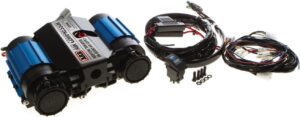
The ARB twin compressor is built to be mounted, not just tossed in the back. It runs off 12V and moves 2.34 CFM at 29 PSI with dual motors hitting 150 PSI max.
It’s compact enough to install in tight spots and it stays put on rough terrain once it’s in. ARB also designed it to power ARB air lockers directly, which makes it a two-for-one if you’re running lockers.
The build quality is serious. Dust, mud, wide temperature swings, it handles all of it. I trust this one when I’m far from help.
The CKMTA12 also runs pneumatic tools and fills camping gear. If you want a permanent install that does more than just tires, this is it.
5. Lasfit X4, Best for Large Tires and Fast Inflation
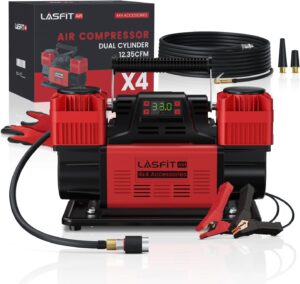
The X4 is the newer player on this list and it comes in swinging. Dual 40mm cylinders push 12.35 CFM on a 1080W motor. LASFIT claims it’s about 49% faster than most portables and based on what I’ve seen, that tracks.
It has a smart auto-stop feature and a digital pressure gauge with four preset modes for different tire types. Handles tires from 33 to 39-plus inches and hooks straight to your 12V battery.
Five-year warranty and fast customer support. At $299.99, it’s aimed at serious off-roaders who want speed and reliability without a permanent install.
6. Smittybilt 2781, Best Value Mid-Range Compressor
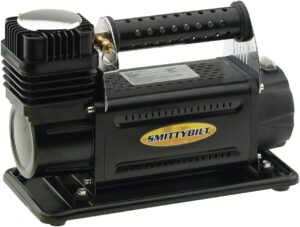
The Smittybilt puts out 5.65 CFM and 160 LPM. One-third horsepower oil-less direct drive motor, 12V power, 30-amp inline fuse.
Maxes at 150 PSI. The 24-foot coil hose with quick-release fittings means you can reach all four tires without dragging the unit around your rig. Portable and easy to stash.
No oil to change, no maintenance hassle. If you want reliable inflation at a reasonable price without overthinking it, the Smittybilt gets it done.
Maintenance Basics
A good compressor lasts years if you treat it right.
Before and after every trip: Check the power cord, battery clamps, and air hose for wear. Wipe the housing down and clear the air intake filter. Dust clogs it fast in desert conditions.
Every few months: Check your pressure gauge against a known good one. If it’s more than a couple PSI off, swap it.
For storage: Run it unloaded for 30 seconds to clear moisture. Coil cords and hoses loosely. Keep it in its case somewhere cool and dry. Disconnect the battery if it’ll sit for a while.
Tire Pressure on the Trail
Here’s the short version.
Sand: Air down to 15-20 PSI. The bigger contact patch keeps you floating instead of digging.
Rocks: 18-25 PSI depending on tire size and terrain. Lower pressure conforms to the surface and reduces the chance of a puncture.
Highway: Back up to whatever your vehicle’s door placard says, usually 30-35 PSI for most trucks. Don’t run low on pavement. You’ll chew sidewalls and burn more fuel.
Too low and you risk sidewall damage or beating up your rims. Too high and you lose traction and the ride gets punishing. There’s some trial and error, and that’s part of figuring out your setup.
FAQ
Which compressor is best for 35-inch tires? The MORRFlate TenSix PSI Pro Gen2, Lasfit X4, and Desert Armor Beast V2 are all built for big tires. The MORRFlate’s auto-stop feature makes it the most hands-off option.
What CFM do I actually need? For tires 33 inches and smaller, 2.0+ CFM is fine. For 35s and up, go 2.5 CFM or higher. Anything under 2.0 CFM will work but it’s slow.
Cigarette lighter or battery clamps? Battery clamps, every time. The lighter socket can’t handle the current draw from most serious compressors without tripping a fuse or losing output.
How do I keep it from overheating? Give it breaks. Most compressors need 5 to 10 minutes to cool after 10 to 15 minutes of heavy use. The units with thermal cutoffs protect themselves, but you still shouldn’t push them continuously.
Can I use these for things besides tires? The ARB twin and the Sherpa BOX AIR are both capable of running pneumatic tools and other air needs. Most portables on this list are tire-focused but can handle camping gear inflation too.
Bottom Line
You don’t need the most expensive compressor on this list. You need one that matches your tire size, your trail style, and how often you’re using it.
Solo overlander running 33s? The Viair 400P is more than enough. Running 37s with a group? Step up to the MORRFlate or the Desert Armor Beast V2.
The wrong call is showing up on the trail with no way to air back up. Pick one, put it in Estes (or whatever you’re driving), and keep it there.
Support the Adventure
When you shop through my affiliate links, you support this blog at no extra cost to you. That keeps the adventures going.
Check out my photography portfolio if you want to bring a piece of the American West home. And if you want to fuel future trips, you can buy me a coffee on Ko-Fi.
Subscribe to the mailing list for new posts, behind-the-scenes adventure, and updates from the Unicorn Squadron.

Theo Maynard is a landscape photographer and adventure blogger based in Salt Lake City. He chases remote desert and mountain light across the American West, documents it all solo, and shares the journey through Unicorn Adventure. He’s on the autism spectrum, and that’s not a footnote, it’s the whole story. He creates to inspire others to get outside, chase what lights them up, and live their best possible life. Unapologetically himself.