


The Best Budget Hiking Gear for Beginners: Trail-Tested Essentials That Won’t Break the Bank
I started building my gear kit on a budget. Most of the trails I hike, Coyote Gulch in Grand Staircase-Escalante, the Navajo Loop at Bryce Canyon, Wheeler Peak in Great Basin, they do not care how much you spent on your backpack. They care whether your feet hurt. They care whether you have water. I have logged thousands of miles across the desert and mountain West from Estes, my 4Runner, and the honest truth is that some of the best gear I have carried cost less than a tank of gas in southern Utah.
If you are on the autism spectrum like I am, gear matters even more. The wrong sock fabric rubbing your ankle for six miles can wreck an entire day. A headlamp with too many strobe modes cycling at random can overload your nervous system before you even reach the trailhead. Budget gear is not about buying the cheapest thing on the shelf. It is about finding the right thing that fits your body, fits your senses, and lets your brain focus on the trail instead of fighting discomfort.
These are the budget hiking essentials I would actually recommend to a beginner. Every product on this list I have either carried, tested, or would hand to a friend heading into the Wasatch for the first time. No gimmicks.
The Best Budget Hiking Gear for Beginners
1. Maelstrom Hiking 40L Backpack, Big Capacity Without the Price Tag
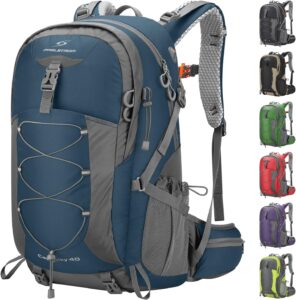
The Maelstrom Hiking 40L Backpack is built from 210D ripstop nylon with water and tear resistance. 40 liters. Includes a rain cover with reflective logo, breathable shoulder straps, adjustable chest buckle, hydration port, and multiple compartments including a waterproof wet pocket.
Forty liters is a sweet spot for beginners. Enough room for a full day kit with layers, food, first aid, and water without encouraging you to overpack. The padded back panel breathes well enough for summer hikes along the Burr Trail, and the chest and hip straps distribute weight so your shoulders are not carrying everything by mile three. The waterproof wet pocket is a small detail that matters more than you think, especially when you need to separate a sweaty base layer from your dry gear. The rain cover stows in its own bottom pocket and deploys fast, which I appreciate when afternoon storms roll over the Uintas with zero warning. For the price, the build quality punches well above its weight. The zippers are smooth, the stitching is clean, and it packs down small enough to toss in Estes without taking up the whole cargo area. If you are buying your first real hiking pack and do not want to spend $150 learning what you like, start here.
2. Merrell Moab 3 Hiking Shoes, The Trail Standard for a Reason
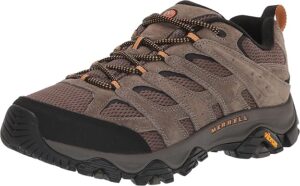
The Merrell Moab 3 Hiking Shoes feature a pigskin leather and mesh upper with 100% recycled laces and webbing. Kinetic Fit ADVANCED insole with reinforced heel cushioning, molded nylon arch shank, EVA foam midsole, and Vibram TC5+ outsole. Bellows tongue and protective toe cap.
The Moab line has been a trailhead staple for years and the third generation keeps everything that works. The bellows tongue actually keeps sand and pebbles out, which is a bigger deal than it sounds when you are hiking red sand country around Monument Valley or the Devils Garden in Grand Staircase. The EVA midsole cushions without feeling mushy, and Merrell’s air cushion in the heel absorbs impact on rocky descents like Rattlesnake Gulch. No break-in period. I laced them up and hit the trail. For sensory-sensitive hikers, the mesh lining is soft and the interior seams sit flat, so there are no hot spots or weird pressure points after miles of wear. The toe cap has saved me from stubbed toes on more root-covered trails than I can count. At this price point, the Moab 3 is the hiking shoe I tell every beginner to try on first.
3. Columbia Silver Ridge Convertible Pants, Two Pants in One
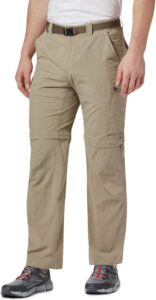
The Columbia Silver Ridge Convertible Pants offer UPF 50 Omni-Shade sun protection with moisture-wicking fabric. Zip-off legs convert to shorts. Partial elastic waistband, gusseted crotch, and multiple secure pockets. Classic fit.
I wore convertible pants on my first serious hike and never looked back. You start the morning in long pants when it is cold and the brush is thick, then zip off the legs by midday when the sun is hammering the slickrock. The Columbia Silver Ridge does this better than most because the zippers sit above the knee at a natural angle, so they do not dig in or feel awkward when you are scrambling. UPF 50 matters more than people think. I have spent full days on exposed ridgelines at Kodachrome Basin where there is zero shade for hours, and sunburn through thin fabric is a real problem. These block it. The moisture-wicking keeps your legs dry on humid summer mornings, and the gusseted crotch gives you range of motion for steep steps and boulder moves. The waistband has enough elastic to stay comfortable without needing a belt on most body types. They are not the lightest hiking pants on the market, but they are durable, well-priced, and versatile enough to be the only pair you bring on a weekend trip.
4. TrailBuddy Trekking Poles, Reliable Sticks That Actually Adjust
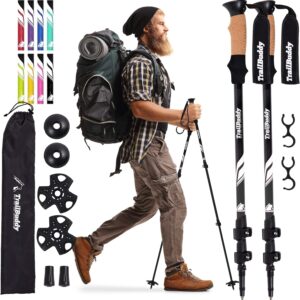
TrailBuddy Trekking Poles are made from aircraft-grade 7075 aluminum, stronger than carbon fiber. Adjustable from 24.5 to 54 inches. Lever lock mechanism for one-handed adjustment. Cork handles with padded wrist straps. Includes threaded tips and accessories for varied terrain.
Trekking poles changed my hiking life, and I am not being dramatic. On steep descents like the switchbacks into Queens Garden at Bryce Canyon or loose scree fields on Quandary Peak in Colorado, poles take pressure off your knees and give you two extra points of contact. TrailBuddy uses 7075 aluminum, which is the same grade used in aviation. It is stronger than carbon fiber at this price and does not shatter if you jam it between rocks. The lever lock system is the real selling point. You flip it open, slide to your height, flip it closed. One hand. No fumbling with twist locks that slip under load. Cork handles absorb sweat and mold to your grip over time, which is a sensory win if you dislike the sticky feeling of rubber grips in hot weather. They adjust short enough for steep uphills and long enough for flat desert crossings outside Escalante. I keep a pair in Estes at all times. If you have never hiked with poles, these are the ones to try first because the price is low enough that you will not feel burned if poles turn out not to be your thing. But they will be your thing.
5. Iron Flask Insulated Water Bottle, Keeps Cold Water Cold All Day
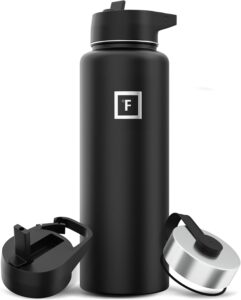
The Iron Flask Insulated Water Bottle features double-wall vacuum insulation. Keeps drinks cold 24 hours or hot 12 hours. Sweat-free exterior. Comes with three leak-proof lids: carabiner straw, flip, and stainless steel. 18/8 stainless steel, BPA-free. Hand wash only.
Hydration is not optional in the desert. I have hiked Badwater Basin in Death Valley where the air temperature hit triple digits before noon, and the difference between cold water and warm water is the difference between finishing the hike and sitting in your car wishing you had planned better. The Iron Flask holds cold water for a full 24 hours, which means you can fill it with ice the night before and still have cold water at the trailhead the next afternoon. The sweat-free exterior keeps the outside of your pack dry, which matters when everything is jammed together. Three lid options give you flexibility. I use the straw lid on the trail because I can drink without stopping, and the stainless steel lid for travel. The 18/8 stainless steel does not hold flavors or leave a metallic taste, which is important if you are sensitive to those things. Only caveat is that the 14, 18, and 22 ounce sizes fit cupholders but the larger sizes do not. I run the bigger size and keep it in a side pocket on my pack. For the price, you are getting vacuum insulation that performs as well as bottles costing two or three times more.
6. Coleman Skydome Tent, Car Camping Shelter That Sets Up in Minutes
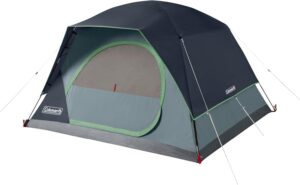
The Coleman Skydome Tent sets up in under 5 minutes with pre-attached poles. 8 by 7 foot floor with 4 foot 8 inch center height. Nearly vertical walls for 20% more headroom. WeatherTec system with welded corners and inverted seams. Tested against 35 mph winds. Fits one queen air mattress.
I am not going to pretend this is an ultralight backcountry tent. It is not. This is a car camping tent, and it is damn good at that job. When I am parked at a campsite near Flaming Gorge or set up at Kodachrome Basin State Park, I want a shelter that goes up fast and keeps weather out. The Skydome does both. Pre-attached poles mean you are not sorting through a pile of disconnected segments in the dark. Five minutes from bag to shelter. The nearly vertical walls are the design choice that makes this tent feel bigger than its footprint. You can actually sit up inside without your head brushing nylon, and the wider door makes dragging in a sleeping pad and gear bag less of a wrestling match. WeatherTec is Coleman’s system of welded floor corners and inverted seams, and it works. I have sat through hard rain in southern Utah and stayed dry inside. Wind-tested to 35 mph is solid for a budget tent. It is not a four-season alpine shelter, but for spring through fall car camping across the American West, you would be hard pressed to find better value.
7. Vriexsd Mini First Aid Kit, Compact Emergency Coverage You Can Actually Carry
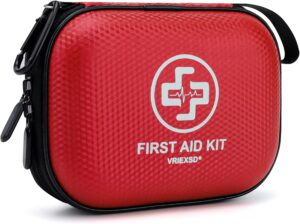
The Vriexsd Mini First Aid Kit packs over 150 medical supplies into a 6.4 by 4.9 by 2.7 inch waterproof EVA case. Includes bandages, gloves, iodine pads, tweezers, tourniquet, and more. Latex-free. Weighs 0.73 pounds with carabiner attachment.
Every pack I carry has a first aid kit in it. Every single one. It does not matter if I am doing a quick two-mile loop at Donut Falls in the Wasatch or a full day push through the Chesler Park loop in Canyonlands, first aid goes in the bag. The Vriexsd kit is the one I recommend for beginners because it covers the basics without making you build your own kit from scratch. Over 150 supplies in a case smaller than a paperback book. The compartmentalized layout means you can find what you need fast, which matters when your hands are shaking because someone just rolled an ankle on a talus field. Everything is latex-free, which is a detail that matters for people with sensitivities. The waterproof EVA shell protects supplies from getting crushed or wet at the bottom of your pack. At under a pound with a carabiner clip, there is no excuse not to carry it. I clip mine to an internal loop in my pack so it is always in the same place. When you need it, you need it fast. Do not cheap out on this category, and do not skip it.
8. Elegear Self-Inflating Sleeping Pad, Memory Foam Comfort for Car Camping
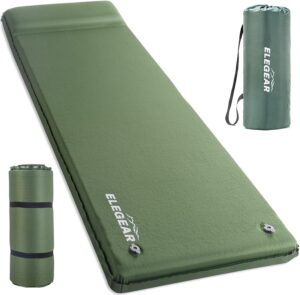
The Elegear Self-Inflating Sleeping Pad uses 26D Hi-Tech memory foam with self-inflation via dual-layer valves in 20 seconds. 77 by 27 inches, 3.15 inches thick. R-value 9.5. Supports up to 800 pounds. 50D stretch knit fabric cover. Weighs 8.1 pounds with shoulder carry bag.
Sleep quality on the trail directly affects how you feel the next morning, and if your nervous system is already working overtime processing a new environment, a bad night of sleep can shut down the whole trip. I take sleep gear seriously. The Elegear pad self-inflates in about 20 seconds, which means you open the valves, go set up the rest of your camp, and come back to a fully inflated pad. The memory foam distributes weight evenly and eliminates those pressure points on your hips and shoulders that wake you up at 2 AM. At 3.15 inches thick with an R-value of 9.5, this pad insulates well enough for cold nights in the Uintas or late fall camping near Mesa Arch. The 50D stretch knit fabric is quiet when you move, which is a sensory detail I appreciate more than most. Some pads crinkle like a chip bag every time you shift position. This one does not. It weighs 8.1 pounds, so this is a car camping pad, not a backcountry ultralight pick. But if you are sleeping next to Estes at a pull-off site or developed campground, the weight is irrelevant and the comfort is unmatched at this price point.
9. Darn Tough Merino Wool Socks, The Last Hiking Socks You Will Ever Buy
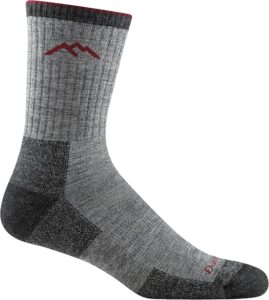
Darn Tough Merino Wool Socks are midweight cushioned socks in micro crew height. 63% merino wool, 35% nylon, 2% Lycra spandex. Seamless construction. Moisture-wicking and temperature-regulating. Lifetime guarantee.
Socks are the most underrated piece of hiking gear. I will die on that hill. Bad socks cause blisters. Blisters end hikes. I have worn Darn Tough socks on everything from summer scrambles at Waterfall Canyon in the Wasatch to cold fall mornings at Mayflower Lakes in Colorado, and they perform in every condition. Merino wool wicks moisture away from your skin and regulates temperature, so your feet stay dry when you sweat and warm when the air cools. The seamless construction eliminates the interior ridges that cause hot spots, which is a massive win for anyone with tactile sensitivities. I cannot wear socks with noticeable seams across the toes. These have none. The micro crew height sits just above boot level, preventing the sock from sliding down and bunching. The blend of 63% merino, 35% nylon, and 2% Lycra gives you softness, durability, and stretch in one package. And then there is the lifetime guarantee. If they ever wear out, Darn Tough replaces them free. No receipt, no questions. That guarantee alone makes them the best per-wear value in hiking. Buy one pair, try them, and you will replace every sock in your drawer.
10. Black Diamond Spot 400 Headlamp, Utah-Built Light That Does Everything
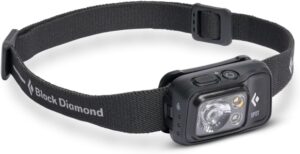
The Black Diamond Spot 400 Headlamp delivers 400 lumens max with proximity, distance, dimming, strobe, red night vision, and lock modes. Red light activates without cycling through white. IPX8 waterproof to 1.1 meters for 30 minutes. Integrated battery meter. 3-year warranty.
Black Diamond is based right here in Utah, and the Spot 400 is their workhorse headlamp. 400 lumens is bright enough to light up a trail in the dark, which you will need if you are chasing sunrise at Mesa Arch or hiking out late from the Golden Cathedral trail in Grand Staircase. The feature I care about most is the red night vision mode that activates directly without cycling through white light first. If you are in a shared campsite or your eyes are already adjusted to the dark, blasting white light ruins everything. Red light preserves your night vision and keeps your nervous system calmer, which matters more than most gear reviewers will tell you. The lock mode prevents the headlamp from turning on inside your pack and draining the batteries, which has happened to me with cheaper headlamps more times than I want to admit. IPX8 waterproof means it can go underwater to about a meter for 30 minutes, so rain is a non-issue. The battery meter tells you exactly how much power you have left instead of guessing. Three-year warranty from a company that stands behind their gear. For the money, there is no better headlamp for hiking.
11. AllTrails Navigation App, Your Digital Trail Guide for Every Hike

AllTrails gives you access to over 400,000 trails worldwide. Filter by length, difficulty, and features. GPS tracking, elevation profiles, community reviews and photos. AllTrails+ adds offline maps, wrong-turn alerts, and advanced trail data.
I use AllTrails on almost every hike. Before I drive Estes out to a trailhead, I pull up the route, check recent reviews, look at the elevation profile, and download the offline map. That last part matters more than anything. Cell service dies fast in places like Grand Staircase-Escalante, Bears Ears, and the backcountry around Flaming Gorge. If your navigation depends on a cell signal, you are gambling. AllTrails+ gives you downloadable offline maps and wrong-turn alerts that buzz your phone when you drift off route, which has saved me from taking wrong forks on trails with confusing junctions. The community review system is genuinely useful because hikers post current conditions, trail closures, and photos that show you what the trail actually looks like right now, not what it looked like in a marketing photo five years ago. For someone new to hiking, this app removes the guesswork from planning. You can filter by distance, elevation gain, difficulty, and even dog-friendliness. I have discovered trails I never would have found through AllTrails reviews alone. It is the single most useful digital tool in my hiking kit, and the free version is solid on its own. The paid upgrade is worth it if you hike in remote areas regularly.
How to Choose Budget Hiking Gear That Actually Works
Start with the gear that touches your body first. Shoes, socks, and your pack are the three items that will make or break a hike regardless of price. A $40 backpack that fits your torso correctly will outperform a $200 pack that does not. Try things on when possible. Walk around the store. Adjust every strap. If something feels off in the first five minutes, it will feel worse at mile five. For boots and shoes, go half a size up from your street shoes because your feet swell during long hikes, and make sure the toe box gives you room to wiggle. Socks should be merino wool or synthetic, never cotton. Cotton holds moisture and creates blisters faster than anything else on the trail.
After footwear and your pack, prioritize navigation and safety. A headlamp and first aid kit are not optional, even on short hikes. Weather changes fast in the mountains, daylight disappears faster than you expect, and a simple rolled ankle can turn a fun afternoon into a serious situation if you are not prepared. Buy your tent and sleeping pad based on how you actually camp. If you drive to campsites, weight does not matter and you can prioritize comfort. If you want to graduate into backcountry hiking later, start lighter now. Most importantly, do not buy everything at once. Build your kit over time, learn what you actually need, and upgrade the pieces that matter most as you put miles on the trail.
Frequently Asked Questions
What is the single best piece of budget hiking gear on this list?
That depends on where you are in your hiking journey. If you have nothing, start with the Merrell Moab 3 shoes. Good footwear is the foundation. If you already have shoes and a basic pack, the Darn Tough socks will improve your comfort more than any other single purchase. If you are planning overnight car camping trips, the Coleman Skydome tent gives you the most value per dollar for shelter. There is no single winner because every hiker has different gaps in their kit.
Is a 40-liter backpack too big for day hikes?
It depends on what you carry and where you hike. For a quick three-mile trail near the Wasatch Front, 40 liters is more than you need. But for a full-day hike in remote areas like Grand Staircase-Escalante where you need extra water, layers, food, first aid, and navigation tools, 40 liters fills up fast. The Maelstrom pack compresses well when it is not full, so it does not flop around on shorter hikes. If you only do short day hikes, a 20 to 25 liter pack is fine. If you want one pack that handles everything from short loops to full-day adventures, 40 liters gives you room to grow.
Are any of these products good for someone with sensory sensitivities?
Yes. Several picks on this list were chosen specifically with sensory considerations in mind. The Darn Tough socks have seamless construction that eliminates interior ridges against your skin. The Elegear sleeping pad uses quiet stretch knit fabric that does not crinkle when you move. The Black Diamond Spot 400 headlamp activates red light directly without forcing you to cycle through bright white modes. The Iron Flask water bottle has no metallic taste. The TrailBuddy trekking poles use cork handles that absorb sweat without feeling sticky. If you are on the autism spectrum or have a sensitive nervous system, gear texture and noise and taste all matter. These products respect that.
Can I use the Coleman Skydome tent for backcountry camping?
Technically yes, but I would not recommend it. The Skydome is designed for car camping. It is spacious and comfortable but it weighs too much to carry on your back for miles. If you are driving to a campsite at Kodachrome Basin or a pull-off along the Burr Trail, it is perfect. If you want to hike into a backcountry site, look for a tent under four pounds with a smaller packed size. The Skydome is three-season rated, so it handles spring through fall weather well, but it is not built for heavy snow loads or extreme alpine conditions.
How long does budget hiking gear last compared to premium options?
Longer than most people expect. The Merrell Moab 3 can handle 500 or more trail miles before the sole wears down, which is comparable to many shoes at double the price. Darn Tough socks are guaranteed for life. The Iron Flask bottle and Coleman tent will last years with basic care. Budget gear usually trades weight savings and boutique materials for durability and value. You might carry an extra half pound on the trail, but your gear will hold up season after season. The place where premium gear pulls ahead is ultralight weight and specialized features for extreme conditions. For most beginners hiking in normal conditions, budget gear performs just fine.
The Trail Does Not Check Your Receipt
I have stood at the rim of Coyote Gulch with a backpack that cost less than dinner at a nice restaurant. I have watched sunrise from Wheeler Peak with budget trekking poles in my hands. The trail does not care about brand names or price tags. It cares whether you showed up, whether you were prepared, and whether you kept moving forward. Good gear makes that easier. But the best gear in the world does not matter if it stays in your closet. Buy what you can afford. Get outside. Start with one trail, one pair of decent shoes, one pack of merino wool socks. Build from there.
Every piece of gear on this list earned its spot because it works, it lasts, and it respects your budget. The best investment you can make is not the gear itself. It is the miles you put on it.
Support the Adventure
To make your walls less boring, check out my photography portfolio and bring a piece of the wild and my story into your home.
If you’d like to fuel future adventures, you can donate a coffee on Ko-Fi. Every cup keeps me chasing sunrises and stories.
When you shop using my affiliate links, every click helps support this blog at no extra cost to you. It’s a small way to keep Unicorn Adventure alive and kicking while I keep exploring.
Subscribe to my mailing list for future updates, new stories, and behind-the-scenes adventures.
Stay connected with me on Instagram and Facebook for more photos and daily inspiration.
Thanks for being part of the journey, Unicorn Squadron!

Theo Maynard is a landscape photographer and adventure blogger based in Salt Lake City. He chases remote desert and mountain light across the American West, documents it all solo, and shares the journey through Unicorn Adventure. He’s on the autism spectrum, and that’s not a footnote, it’s the whole story. He creates to inspire others to get outside, chase what lights them up, and live their best possible life. Unapologetically himself.
2 Comments
Best Hiking Gifts Under $20 | Affordable Gear for Outdoor Lovers
[…] you pick out budget hiking gear, it really pays to focus on durability, weight, and versatility. You’re carrying everything, […]
The Best Jackets for Hiking (From Someone Who Has Been Caught in Everything) » Unicorn Adventure %
[…] jacket offers solid waterproof protection at a budget friendly price, making it worth considering for casual hikers who need basic weather […]