

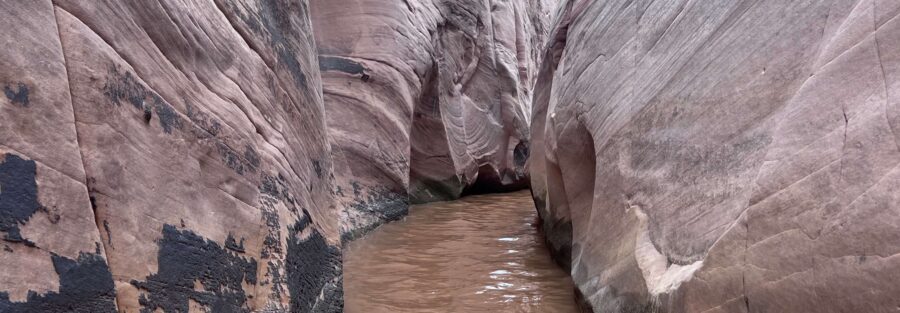
Some trails have a payoff at the end. Zebra Slot Canyon is the payoff the whole way through.
Zebra and Tunnel Slot Canyons sit off Hole-in-the-Rock Road in Grand Staircase-Escalante National Monument, about 13 miles south of Escalante. The route covers 6.6 miles through some of the most visually striking terrain in southern Utah. I drove Estes down the dirt road with no real agenda and came out two hours later completely sold on slot canyon hiking. My brain, which normally runs about six overlapping conversations at once, went quiet in there. The walls press in, the light drops to a thin stripe overhead, and the striped sandstone just pulls your focus.
Here’s everything you need to hike Zebra and Tunnel Slot Canyons.
Quick Facts
| Trail Name | Zebra and Tunnel Slot Canyons |
| Location | Grand Staircase-Escalante NM, near Escalante, Utah |
| Coordinates | 37.6399° N, 111.4434° W |
| Distance | 6.6 miles (round trip) |
| Elevation Gain | 469 feet |
| Difficulty | Moderate |
| Time | 3-5 hours |
| Dogs Allowed | No (narrow slot sections too tight for most dogs) |
| Fee | None (no day-use fee at this trailhead) |
| AllTrails | View on Alltrails |
How to Get There
From Escalante, head east on Highway 12 for about 5 miles. Turn south onto Hole-in-the-Rock Road, which is unpaved. Follow it for approximately 8 miles to the trailhead pull-off on the left side of the road. The GPS coordinates (37.6399, -111.4434) will get you there. This road is generally passable in a standard vehicle when dry, but high clearance is strongly recommended. After any rain, Hole-in-the-Rock Road becomes slick, rutted clay. Don’t test it in a sedan.
Parking Information
There’s no formal parking lot. The trailhead is a widened pull-off along Hole-in-the-Rock Road with room for roughly a dozen vehicles. No facilities, no vault toilets, nothing. Use the bathroom in Escalante before you head out. Arrive early, especially on spring and fall weekends. The pull-off fills up fast, and options along the road are limited.

Cell Service and Navigation
Cell service disappears before you reach the trailhead. Hole-in-the-Rock Road is well off the grid. Download your trail map through AllTrails or Gaia GPS before you leave town. A paper map is a solid backup. Navigation on trail isn’t complicated but there are wash crossings and junctions where it’s easy to second-guess yourself without a reference. GPS tracks well out here even without cell service.
What to Expect on Zebra and Tunnel Slot Canyons
The Trail
The route starts with a sandy wash walk across open desert before dropping into the canyon network. The terrain alternates between wide sandy wash and technical slot. You’ll do some boulder scrambling and in wet conditions may encounter standing water inside Zebra Canyon. The approach is mostly straightforward navigation through the wash. Pay attention at junctions and reference your map.
Zebra is the main event. The canyon walls are banded with alternating layers of red, orange, and cream sandstone that look exactly like the name suggests. In the narrowest sections you’re turning sideways to fit through. The light inside is incredible, especially mid-morning when a sliver of blue sky runs the length of the slot above you. This is where you slow down and stop rushing. Bring a wide-angle lens if you shoot. A tripod helps if the light is low.
Tunnel is less narrow than Zebra but has its own draw. A short tunnel-like section cuts through the rock and pops you out the other side. Less dramatic than Zebra but worth doing if you’re already out there. Most hikers combine both canyons in the same day. The extra mileage is worth it.

Trail Difficulty and Length
The route is 6.6 miles round trip with 469 feet of elevation gain. It’s rated moderate, which tracks. The sandy wash sections are slower going than the mileage suggests, and scrambling through the slot requires some body awareness and flexibility. It’s not technical climbing, but it’s more physical than a standard trail hike. Plan for 3 to 5 hours depending on pace and how long you spend inside the canyons. Flash flood risk is real in slot canyons. Check the weather before you go, not just at the trailhead but for the entire watershed upstream.
Dog Friendly?
No. Zebra Slot Canyon’s narrow sections are too tight for most dogs to navigate safely, and the potential for standing water adds another layer of difficulty. Leave them home for this one.
What to Bring
At least 2 to 3 liters of water per person. The desert approach is exposed and the sandy terrain will drain you faster than expected. Sun protection is essential for the open wash sections. Wear shoes you don’t mind getting muddy or wet, because water inside the slot is possible depending on recent rain. A headlamp is useful inside the darker sections of the canyon. Bring your camera and a wide-angle lens. If you own a tripod and have the patience to carry it, you’ll want it. The light in Zebra Canyon is worth the effort.

Best Time to Hike Zebra and Tunnel Slot Canyons
Spring (April through June) and fall (September through October) are the best windows. Temperatures are manageable and the light in the canyon is excellent. Summer is brutal in the open wash sections and flash flood season is at its peak. Winter is doable but cold snaps can make the approach road muddy and the canyon interior icy.
For photography, mid-morning light works best inside Zebra Canyon, after the sun is high enough to throw light down into the slot but before it washes out completely. The striped walls photograph best when the contrast between shadow and direct light is strong. Overcast days are actually great for slot canyon photography because the diffused light eliminates harsh shadows and renders the banding more evenly.
Rules and Regulations
Zebra and Tunnel Slot Canyons fall under BLM management as part of Grand Staircase-Escalante National Monument. There is no day-use fee at this trailhead. Leave No Trace principles apply fully. Pack out everything. Don’t touch or disturb rock formations. Stay in the wash and on established routes to prevent erosion. Flash flood risk is serious and BLM periodically closes trails after significant rain events. Check current conditions at the Escalante Interagency Visitor Center before heading out.

Where to Stay Near Escalante
Escalante has a handful of good lodging options in town. Entrada Escalante Lodge and Canyon Country Lodge are solid bases for Grand Staircase trips.
Camping Nearby
Dispersed camping is available on BLM land throughout Grand Staircase-Escalante. Cedar Point, South Turkey, and Spencer Flat are all in the area, primitive sites with no hookups and no reservations. Hole-in-the-Rock Road itself has dispersed camping along its length, which puts you close to the trailhead.
The Calf Creek Recreation Area campground about 15 miles east of Escalante on Highway 12 is a small, reservable option at the Lower Calf Creek Falls trailhead. It fills fast, so plan ahead on Recreation.gov.
Nearby Adventures
If you’re going deep on slot canyons, Dry Fork Narrows with Peekaboo and Spooky Slot Canyons is the obvious next move. It covers 6.0 miles with 656 feet of gain and is accessible further down Hole-in-the-Rock Road. Peekaboo and Spooky are arguably more dramatic than Zebra in terms of technical difficulty and visual impact.
For a complete contrast, Lower Calf Creek Falls is 6.1 miles with 531 feet of gain and ends at a 126-foot waterfall. And Escalante Natural Bridge is a shorter out-and-back at 4.4 miles and 291 feet of gain worth stacking onto a multi-day trip.
For drives, Moki Dugway is one of the most dramatic roads in Utah and a short drive from the monument. The Burr Trail is another essential scenic route in this area.
Off the trail, the Anasazi State Park Museum in Boulder has actual Ancestral Puebloan artifacts and a reconstructed village site. The Escalante Petrified Forest State Park is a quick stop with colorful badlands and fossilized wood. Both are easy adds to a Grand Staircase itinerary.
Plan This Hike
AllTrails has the full Zebra and Tunnel route with trail maps, recent conditions, and user reviews. Download the map before you lose signal on Hole-in-the-Rock Road. Knowing what other hikers encountered recently, especially around water in the slot, will help you prepare.
AllTrails Pro is worth it for Grand Staircase trips where connectivity is unreliable and offline navigation matters. Desert terrain with limited landmarks is exactly where offline maps earn their keep.
Chase the Quiet
Zebra Canyon does something to your sense of scale. Outside, the desert is vast and loud with emptiness. Inside the slot, the world compresses to a three-foot-wide strip of sky and banded walls that block out everything else. You can’t be anywhere but there. That’s not something I say lightly. Being fully present is hard for my brain. Zebra makes it unavoidable.
Support the Adventure
To make your walls less boring, check out my photography portfolio and bring a piece of the wild and my story into your home.
If you’d like to fuel future adventures, you can donate a coffee on Ko-Fi. Every cup keeps me chasing sunrises and stories.
When you shop using my affiliate links, every click helps support this blog at no extra cost to you. It’s a small way to keep Unicorn Adventure alive and kicking while I keep exploring.
Subscribe to my mailing list for future updates, new stories, and behind-the-scenes adventures.
Stay connected with me on Instagram and Facebook for more photos and daily inspiration.
Thanks for being part of the journey, Unicorn Squadron!
Theo Maynard is a landscape photographer and adventure blogger based in Salt Lake City. He chases remote desert and mountain light across the American West, documents it all solo, and shares the journey through Unicorn Adventure. He’s on the autism spectrum, and that’s not a footnote, it’s the whole story. He creates to inspire others to get outside, chase what lights them up, and live their best possible life. Unapologetically himself.