
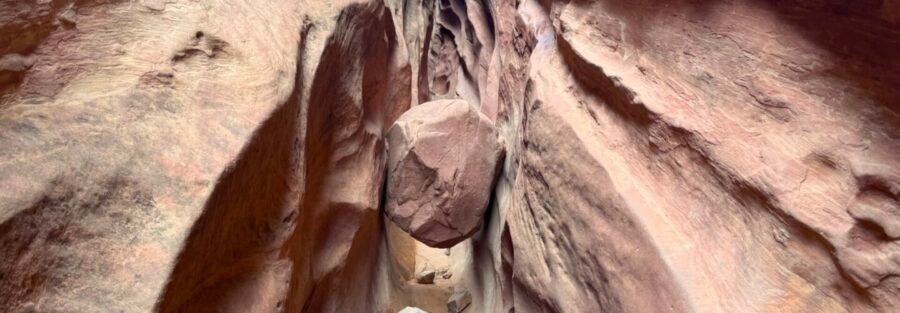
Little Wild Horse Canyon is one of the best slot canyon hikes in Utah. It’s also one of the most accessible, which is a rare combination.
The trail is in the San Rafael Swell, accessed off Goblin Valley Road about 24 miles northwest of Hanksville. The full loop combines Little Wild Horse Canyon with Bell Canyon for 8.0 miles and 787 feet of gain through two connected slot canyon systems. The walls twist and tighten in Little Wild Horse, pressing close enough to force you sideways through the narrowest sections. The rock shifts from deep red to orange to soft pink depending on the angle of the light overhead. Bell Canyon is wider and more open, giving you room to breathe before the loop closes back to the trailhead.
Here’s everything you need to hike Little Wild Horse Canyon.
Quick Facts
| Trail Name | Little Wild Horse Canyon / Bell Canyon Loop |
| Location | San Rafael Swell, near Hanksville, Utah |
| Coordinates | 38.5830, -110.8029 |
| Distance | 8.0 miles (full loop) / 3-4 miles (out-and-back partial) |
| Elevation Gain | 787 feet |
| Difficulty | Moderate |
| Time | 4-6 hours (full loop) |
| Dogs Allowed | Yes (on leash, with caveats for tight sections) |
| Fee | None |
| AllTrails | View on AllTrails |
How to Get There
From Hanksville, take UT-24 west for approximately 18 miles. Turn right onto Goblin Valley Road (State Route 101). Drive about 5 miles, then turn left onto the signed dirt road leading to the Little Wild Horse Trailhead. Follow the dirt road to the trailhead at the end. The road is accessible by most vehicles in dry conditions. High-clearance is preferred but not strictly required on this particular approach. Load the coordinates (38.5830, -110.8029) before leaving UT-24 since cell service is gone before the Goblin Valley Road turnoff. Flash flood risk is serious in slot canyons. Check weather for the full regional watershed before entering the canyon.
Parking Information
A large dirt parking lot serves the trailhead with room for many vehicles. No fee. Restrooms and informational signs at the trailhead. The lot fills on popular spring and fall weekends. Arrive before 8 a.m. to secure a spot and get into the canyon before the crowd. This trailhead is busier than most in the San Rafael Swell because the loop is legitimately one of the best family-accessible slot canyon experiences in Utah.

Cell Service and Navigation
No cell service at the trailhead or in the canyon. Download your map offline through AllTrails before leaving Hanksville. The loop junction and the connection between Little Wild Horse and Bell Canyon require navigation attention. Having a GPS track loaded removes the guesswork at the junctions. Flash flood risk in slot canyons is not optional information: check the full regional weather forecast, not just the local trailhead conditions, before entering. The San Rafael Swell can funnel water through narrow slots with no warning.
What to Expect on Little Wild Horse Canyon
Little Wild Horse Canyon
The trail starts at the trailhead and enters Little Wild Horse Canyon from the south end of the loop. The canyon narrows quickly and begins the slot section that defines the hike. Walls press close together, rising high above and leaving a strip of sky at the top. The sandstone is smooth and sculpted, banded in deep red, orange, pink, and yellow that shifts as the light angle changes through the day. The narrow sections require sideways movement and occasional scrambling over boulders. Nothing requires technical equipment. You need to be comfortable in constricted spaces and moving your body across uneven rock. The canyon is cool in the shade of the slot walls even on warm desert days.
Bell Canyon
The loop connects to Bell Canyon at the north end. Bell is wider, more open, and less intensely slotted than Little Wild Horse. It gives you room to move and different views of the San Rafael Swell surrounding terrain. The return leg through Bell Canyon brings you back to the trailhead from the east end of the loop. The variation in terrain between the two canyons is one of the reasons the full loop is worth doing over an out-and-back: two distinct experiences in one day.

Trail Difficulty and Length
The full Little Wild Horse / Bell Canyon Loop is 8.0 miles with 787 feet of elevation gain. Moderate is the accurate rating. The narrow sections require scrambling and tight navigation but no technical skills. The distance is the primary commitment. Budget 4 to 6 hours for the full loop at a comfortable pace with time in the canyon. Flash flood risk is the most important safety consideration regardless of fitness level. Never enter a slot canyon if there’s any precipitation in the regional forecast.
Dog Friendly?
Yes, with real caveats. Dogs are allowed on leash. The tightest sections of Little Wild Horse Canyon can be impassable for larger dogs. Smaller, agile dogs manage the scrambles and narrow passages. Larger dogs may need to be lifted through some sections or may not fit at all. Know your dog before committing. No water sources on trail. Bring significantly more water than you think your dog needs. Start early in summer to beat peak heat on the exposed sections outside the canyon.

What to Bring
At least 3 liters of water per person for an 8-mile loop in the desert. The canyon shade helps but the approach and Bell Canyon sections are exposed. Sun protection for the open sections. Trail shoes with grip and flexibility for scrambling and the tight canyon navigation. A small pack or no pack for the narrowest sections where width matters. A camera with a wide-angle lens for the canyon interior and a 35mm or 50mm for isolating individual wall texture and color bands. A headlamp in case you run longer than expected. Flash flood awareness: know what the weather is doing before you enter and have a plan for exiting if it changes.
Best Time to Hike Little Wild Horse Canyon
Spring (March through May) and fall (September through November) are the strongest windows. Temperatures are manageable and the canyon light is excellent. Summer is hot on the exposed approach sections and flash flood risk from monsoon storms peaks from July through September. An early start is mandatory in summer. Winter is doable in mild years but ice can form in the shaded canyon sections and cold canyon temperatures make the narrow passages uncomfortable without layers.
For photography, early morning in Little Wild Horse is the move. The canyon faces generally north-south and the light conditions inside shift dramatically through the day. The first two hours after entering the canyon at sunrise produce the strongest color rendering as the sun angle begins sending light down into the slot at a warm angle. Midday overhead light washes out the color differentiation. A wide-angle lens handles the full wall-to-wall interior. A polarizing filter cuts glare on the smooth sandstone surfaces.
Rules and Regulations
Little Wild Horse Canyon is BLM land. No permits, no fees. Leave No Trace fully: pack out everything, don’t build cairns or alter the canyon surfaces, and stay in the established canyon route through the slot sections. Flash flood risk is real and BLM occasionally closes the canyon after significant rain events. Check current conditions before driving out. The trailhead restrooms and signage are maintained by BLM, use them, leave them better than you found them.
Where to Stay Near the San Rafael Swell
Hanksville is the practical base, about 24 miles east with basic motels and all services. For more amenities, Moab is about 2 hours east and Green River is about 1.5 hours north. Goblin Valley State Park, about 5 miles back on Goblin Valley Road, has a campground with hookups reservable through Utah State Parks. For points travelers, check available Marriott Bonvoy properties, IHG Rewards hotels, and Hilton Honors options in Moab, Green River, or Salt Lake City along your route.
Camping Nearby
Dispersed BLM camping is available near the trailhead and throughout the San Rafael Swell. The Little Wild Horse trailhead area has established dispersed sites that make a natural base camp. No hookups, no facilities beyond the trailhead restrooms. Goblin Valley State Park campground, about 5 miles away on Goblin Valley Road, is the nearest option with hookups and reservable sites through Utah State Parks.
Nearby Adventures
The full Bell Canyon loop is the natural extension of a Little Wild Horse day if you do the partial out-and-back on your first visit. Leprechaun Canyon (2.2 mi / 147 ft) off Highway 95 is a shorter slot canyon option for the same multi-day San Rafael Swell itinerary. Goblin Valley State Park, 5 miles back on Goblin Valley Road, has both the Valley of the Goblins and the Goblin’s Lair Trail and pairs naturally with a Little Wild Horse day.
For the broader Hanksville area, Factory Butte, the Bentonite Hills, and Moonscape Overlook are all within 30 to 45 minutes and cover completely different landscape experiences from the slot canyon terrain. The Mars Desert Research Station is on Cow Dung Road if you want the extraterrestrial detour.
For established Escalante trail hikes south of the Swell, Lower Calf Creek Falls (6.1 mi / 531 ft) and Moki Dugway are worth building into a multi-day Hanksville and Escalante road trip through the canyon country.
Plan This Hike
AllTrails has the Little Wild Horse Canyon / Bell Canyon Loop with a downloadable map, recent user conditions, and notes on canyon conditions and flash flood risk from current hikers. The user reports on this trail are particularly useful because conditions in the slot sections can change significantly after any weather event.
AllTrails Pro is worth it for a San Rafael Swell trip where you’re navigating multiple slot canyon objectives with no cell service. Download Little Wild Horse, Bell Canyon, and Goblin Valley maps before leaving Hanksville.
Chase the Quiet
Little Wild Horse Canyon is popular because it delivers. The narrow sections, the color of the sandstone, the way the walls close in and then open and then close again as the canyon twists: it’s exactly what slot canyon hiking is supposed to feel like. The loop format means you never repeat terrain. Get there early, stay in the canyon long enough to let the light shift, and remember that the Bell Canyon return is worth more than the out-and-back shortcut. The full 8 miles earns the full experience.
Support the Adventure
To make your walls less boring, check out my photography portfolio and bring a piece of the wild and my story into your home.
If you’d like to fuel future adventures, you can donate a coffee on Ko-Fi. Every cup keeps me chasing sunrises and stories.
When you shop using my affiliate links, every click helps support this blog at no extra cost to you. It’s a small way to keep Unicorn Adventure alive and kicking while I keep exploring.
Subscribe to my mailing list for future updates, new stories, and behind-the-scenes adventures.
Stay connected with me on Instagram and Facebook for more photos and daily inspiration.
Thanks for being part of the journey, Unicorn Squadron!
Theo Maynard is a landscape photographer and adventure blogger based in Salt Lake City. He chases remote desert and mountain light across the American West, documents it all solo, and shares the journey through Unicorn Adventure. He’s on the autism spectrum, and that’s not a footnote, it’s the whole story. He creates to inspire others to get outside, chase what lights them up, and live their best possible life. Unapologetically himself.
2 Comments
Hanksville Utah Travel Guide: Slot Canyons, and more
[…] Full trail guide: Little Wild Horse Canyon and Bell Canyon Loop […]
Long Dong Silver Utah: Hiking Guide to Unique Rock Formation
[…] to its name. In Goblin Valley, hike the Valley of the Goblins or scramble into Goblin’s Lair. Little Wild Horse Canyon covers 8.0 miles with 787 feet of gain through one of the best slot canyons in Utah. Leprechaun […]