

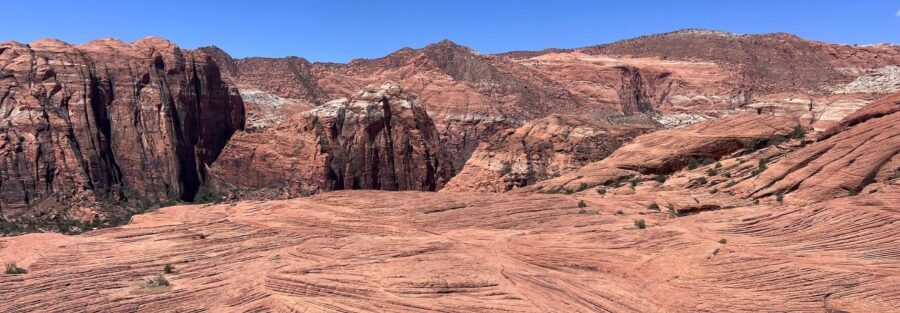
Hike the Petrified Sand Dunes in Snow Canyon State Park near St. George, Utah: 1 mile of open-roaming ancient sand dunes solidified into Navajo Sandstone with canyon and lava flow views. Easy, dog-friendly.
Quick Facts
| Trail Name | Petrified Sand Dunes |
| Location | Snow Canyon State Park, near St. George, Utah |
| Coordinates | 37.2132° N, 113.6457° W |
| Distance | ~1 mile (open exploration; distance varies with wandering) |
| Elevation Gain | ~200 feet (exploration-based) |
| Difficulty | Easy |
| Time | 30–75 minutes |
| Dogs Allowed | Yes, on leash |
| Fee | $15 per vehicle to enter Snow Canyon State Park |
| AllTrails | View on AllTrails |
How to Get There
From St. George, take UT-18 north and follow signs to Snow Canyon State Park. The park entrance is about 20 minutes from downtown. Inside the park, drive north on Snow Canyon Drive to the Petrified Sand Dunes trailhead, signed from the main park road. From Las Vegas: I-15 north about 1.5-2 hours to St. George, then UT-18 north. From Salt Lake City: I-15 south about 4-4.5 hours to St. George. Snow Canyon is a 20-minute drive from the St. George area hotel corridor.
Parking Information
Designated parking at the trailhead off Snow Canyon Drive. Peak season (spring and fall weekends) fills the lot before mid-morning. Arrive before 8 a.m. for a space. $15 per vehicle park entry at the gate. The Petrified Sand Dunes trailhead is separate from the main visitor area; follow park road signs. 
What to Expect at the Petrified Sand Dunes
The Petrified Sand Dunes are the product of ancient desert dunes, the same type of sand dune systems visible today in places like Great Sand Dunes National Park, that were buried, compacted, and cemented into Navajo Sandstone over millions of years. The original dune architecture is preserved in the rock: the sweeping curves and cross-bedded layers visible in the stone are the shapes of the original sand deposit, frozen at the moment of burial and exposed by erosion over time. Walking on the petrified dunes is walking on the preserved shape of an ancient desert. The surface underfoot is solid sandstone that undulates in wave-like forms, creating a landscape that feels like walking on a frozen sea. The color palette, reds, pinks, and oranges from iron oxide in the sandstone, is characteristic of southern Utah but at its most vivid in the dune formations. The black lava flows visible in Snow Canyon below provide a contrast: the young volcanic rock cutting through the ancient sedimentary terrain. The exploration is open: there’s no formal trail through the dunes. You step onto the formation and wander. The dunes are porous enough that any direction offers new angles on the formations and new views of the surrounding canyon walls and the Pine Valley Mountains in the distance. For photography: the petrified dune surface is the primary subject. The cross-bedded rock layers are most visible when light hits them at an angle, early morning from the east, late afternoon from the west. The curved dune shapes create natural leading lines. Wide-angle for the dune field in landscape context, mid-range for the cross-bedding detail and color variation. The black lava flows visible below from the higher dune positions provide a distinctive foreground-background contrast.
Trail Difficulty and Length
The route is approximately 1 mile with 200 feet of gain. Easy is accurate. The open-roaming character means total distance depends on how far you wander; the 1-mile figure represents a basic exploration. Budget 30-75 minutes depending on pace and photography time.
Dog Friendly?
Yes. Dogs are permitted on leash. The sandstone surface heats quickly in summer; check paw temperatures throughout the visit and redirect dogs to shaded rock sections when available. No water on the dunes; bring water for dogs. The open terrain means dogs can walk beside you throughout the exploration. 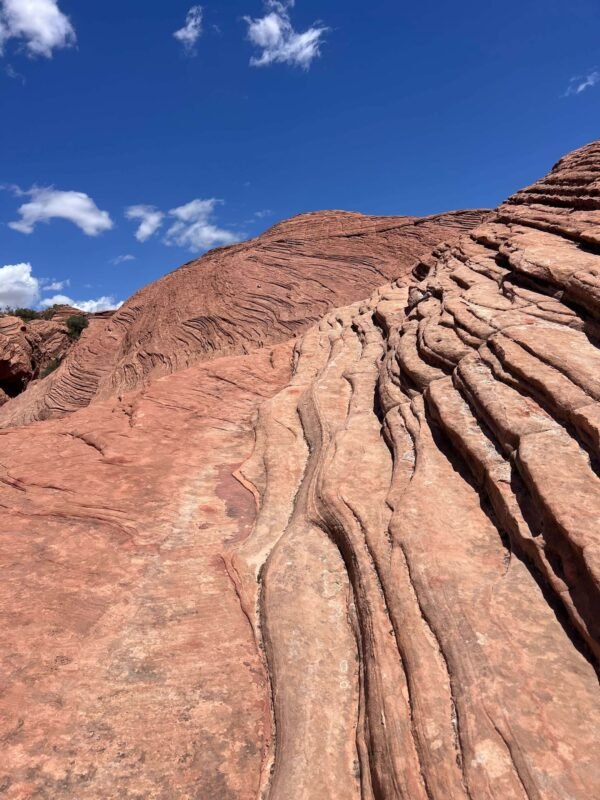
What to Bring
Water: 1.5 liters for a short desert exploration with no shade. Sun protection for the fully exposed dune surface. Comfortable shoes with grip for the dune surface, which has some unevenness. Camera with wide-angle and mid-range capability for the dune formations.
Best Time to Visit
Spring (March through May) and fall (September through November) are the most comfortable windows. The petrified dune color saturation is highest in soft morning or late afternoon light; midday overhead light flattens the cross-bedded texture. Early morning visits in fall give the warmest color on the sandstone and the coolest temperatures for the open desert exposure. Summer is possible with morning starts before 8 a.m.; the exposed dune surface radiates heat quickly once the sun reaches it. Winter at Snow Canyon’s elevation is typically accessible and can deliver dramatic low-angle light on the dune formations.
Rules and Regulations
Stay in the designated open hiking areas. Do not remove rocks or sandstone material. Leave No Trace throughout. Dogs on leash. $15 per vehicle park entry. Fires only in designated campground areas. 
Where to Stay Near St. George
St. George has full city hotel infrastructure. For points travelers, check available Marriott Bonvoy properties in St. George, IHG Rewards hotels in St. George, and Hilton Honors options in St. George.
Camping Nearby
Snow Canyon State Park has a developed campground inside the park. In-park camping enables sunrise visits to the Petrified Sand Dunes in morning light before the parking lot fills. Reservations through reserveamerica.com.
Nearby Adventures
The full Snow Canyon catalog: Lava Tube Trail, Butterfly Trail, and Jenny’s Canyon. All four Snow Canyon trails can be combined in a full park day. Petrified Sand Dunes and the Lava Tube Trail together cover both the ancient sedimentary geology and the young volcanic geology of Snow Canyon in a single park visit. Yant Flats to Candy Cliffs and Yellow Top (5.3 miles / 800 ft) is the other major slickrock hiking destination in the St. George catalog. Snow Canyon’s Petrified Dunes and Yant Flats together give a comprehensive slickrock experience from the same St. George base. Zion National Park is about 40 minutes east on UT-9. Snow Canyon as a morning stop before heading to Zion is a natural itinerary for visitors approaching from the St. George direction.
Plan This Hike
AllTrails has the Petrified Sand Dunes mapped with the parking area location and offline capability. Download before heading into the park. Plan your visit on AllTrails and pull the offline map while you’ve got signal in St. George.
Chase the Quiet
The Petrified Sand Dunes are the shapes of a desert that existed millions of years ago, preserved in the sedimentary record and exposed by erosion. The curves in the rock are the curves of the original dune faces. The cross-bedded layers are the angles of the wind that built the dune. All of that is visible in the surface underfoot when you walk across them. The desert that made these shapes is long gone; the shapes are still here. There’s a specific kind of stillness in a geology that complete.
Support the Adventure
To make your walls less boring, check out my photography portfolio and bring a piece of the wild and my story into your home. If you’d like to fuel future adventures, you can donate a coffee on Ko-Fi. Every cup keeps me chasing sunrises and stories. When you shop using my affiliate links, every click helps support this blog at no extra cost to you. It’s a small way to keep Unicorn Adventure alive and kicking while I keep exploring. Subscribe to my mailing list for future updates, new stories, and behind-the-scenes adventures. Stay connected with me on Instagram and Facebook for more photos and daily inspiration. Thanks for being part of the journey, Unicorn Squadron!
Theo Maynard is a landscape photographer and adventure blogger based in Salt Lake City. He chases remote desert and mountain light across the American West, documents it all solo, and shares the journey through Unicorn Adventure. He’s on the autism spectrum, and that’s not a footnote, it’s the whole story. He creates to inspire others to get outside, chase what lights them up, and live their best possible life. Unapologetically himself.