

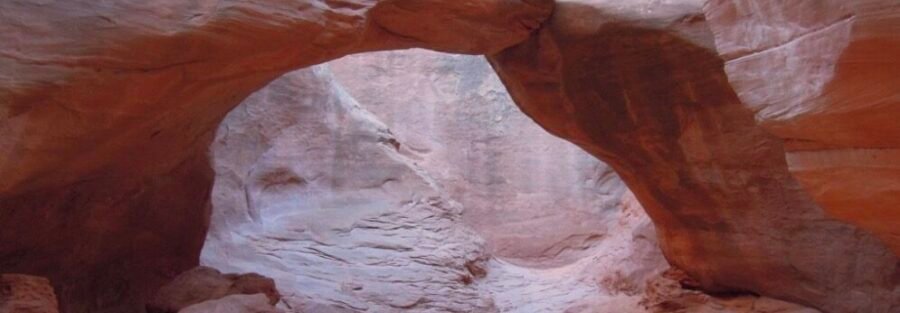
Not every trail needs to be a suffer-fest to be worth doing. Sand Dune Arch is proof. It’s a quarter mile of soft sand through a slot between sandstone fins, and at the end of it, tucked in the shade of those same fins, is an arch that most visitors to Arches National Park walk right past without knowing it exists. The trailhead sits between Balanced Rock and the Windows, near the middle of the park road, and the parking lot gets a fraction of the traffic that the marquee stops attract.
Quick Facts
| Trail Name | Sand Dune Arch Trail |
| Location | Arches National Park, near Moab, Utah |
| Coordinates | 38.7648° N, 109.5833° W |
| Distance | 0.4 miles roundtrip |
| Elevation Gain | Less than 50 feet |
| Difficulty | Easy |
| Time | 20-30 minutes |
| Dogs Allowed | No |
| Fee | $35 per vehicle (America the Beautiful Pass accepted) |
| AllTrails | View on AllTrails |
How to Get There
Arches National Park is 5 miles north of Moab on US-191. Enter the park at the main entrance, then follow Arches Scenic Drive north. The Sand Dune Arch parking area is on the right side of the road, roughly halfway through the park between Balanced Rock and the Windows Section turnoff. It’s clearly signed. You’ll see the Broken Arch trailhead sign as well, since the two share a parking lot.
From Salt Lake City, plan about 4 hours south on I-15 and east on US-191. From Grand Junction, Colorado, it’s roughly an hour west. Once inside the park, the drive to the Sand Dune Arch parking area takes about 10-12 minutes from the entrance.
Timed entry reservations are required at Arches during peak season, typically April through October. Book your window at recreation.gov before you arrive. Without one, you may not get into the park during busy periods.
Parking Information
The Sand Dune Arch and Broken Arch shared parking lot is smaller than the Devils Garden and Windows lots, and it fills up. Spring and fall mornings can see it at capacity by mid-morning. Arrive early or time your timed entry reservation for an early window to guarantee a spot.
No facilities at this trailhead. Restrooms are available at the Devils Garden area, the Windows area, and the visitor center near the park entrance. Plan accordingly.
Cell Service and Navigation
Cell coverage inside Arches is inconsistent and tends to drop the further north you drive from the entrance. Download AllTrails or the NPS Arches app offline before you leave Moab.
Navigation isn’t really the challenge on Sand Dune Arch. The trail is short, well-defined, and contained between the fins. But having offline maps on your phone is a good habit for any Arches visit, and this one sets you up well if you decide to extend the day onto Broken Arch or the Devils Garden trails.
What to Expect on the Sand Dune Arch Trail
The Trail
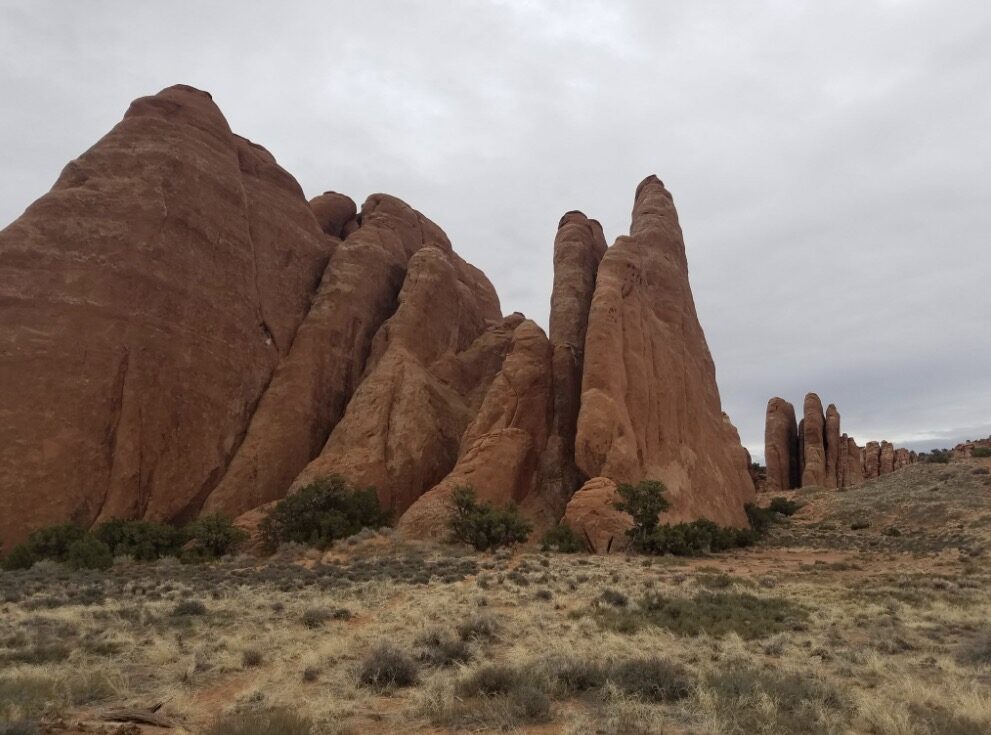
The trail starts at the parking lot and immediately enters the gap between two tall sandstone fins. The path is soft sand the entire way, which makes it easy on the joints and genuinely pleasant underfoot. The fins rise on both sides, narrowing the sky to a strip of blue overhead. In summer, this corridor stays shaded for a good portion of the day, which is a legitimate amenity when the rest of the park is baking.
The walk takes maybe 10 minutes at an easy pace. There’s nothing technical here, no scrambling, no exposure, no route-finding. It’s a corridor through rock that opens into a small sandy bowl where the arch sits.
The Arch
Sand Dune Arch spans a narrow opening in the sandstone fins, small relative to the park’s marquee arches but beautifully framed by the surrounding rock and the deep sand at its base. The scale is intimate. You can step right up to it, stand underneath it, and let kids play in the sand below it without any safety concerns. That’s part of what makes this one special.
The arch catches interesting light in the morning when the sun angles into the slot between the fins. For photography, get there early. By midday, the direct light is mostly gone and the contrast between the shaded slot and the bright sky outside can be tricky to expose for. Morning is the sweet spot.

Trail Difficulty and Length
Easy is accurate. The trail is 0.4 miles roundtrip with negligible elevation change. Soft sand is the only real surface variation. This is appropriate for toddlers, older adults, anyone recovering from an injury, or any hiker who wants a short, accessible stop that still delivers a genuine arch experience.
Budget 20-30 minutes for the round trip with time at the arch. If you’re combining it with Broken Arch from the same parking lot, add another 45 minutes to an hour for that out-and-back.
Dog Friendly?
No. Arches National Park prohibits pets on all trails, including Sand Dune Arch. Dogs are permitted in the parking area and on paved roads within the park, but must stay leashed and off unpaved surfaces. If your dog is with you, they can wait comfortably in the parking lot while you do the quick 20-minute hike. Given the shaded nature of the trail and the short duration, this is one of the more reasonable park hikes to do quickly and get back to your dog. That said, in summer heat, never leave a dog in a parked vehicle. Corona Arch Trail on BLM land west of Moab is the dog-friendly alternative that delivers a comparable desert arch experience.
What to Bring
This is a 20-minute hike, so your full pack isn’t necessary. Bring water regardless, at least a liter per person. Sun protection for the walk from the parking lot and back. Comfortable shoes, anything works here, but soft-soled shoes feel good in the sand.
For photography: a wide-angle lens for the arch framing and a willingness to get low in the sand. The arch looks best from a low angle that uses the sandy foreground. A tripod is useful if you’re shooting in the shaded slot where light levels drop. Morning is the window for direct light in the corridor.
Best Time to Hike Sand Dune Arch
Spring and fall are the prime seasons for Arches generally, and Sand Dune Arch is no exception. March through May and September through November bring manageable temperatures and good light.
In summer, Sand Dune Arch has a real advantage over most Arches trails: the shaded slot keeps the corridor cooler than exposed slickrock hikes. It’s still hot in the parking lot and on the walk in, but the arch itself sits in a natural air pocket that provides relief. This makes it a reasonable summer stop, especially at midday when other hikes are miserable.
Winter is quiet and cold. The trail is accessible in most winter conditions since there’s no elevation and the sandstone fins provide some wind protection. Snow in the fins is beautiful for photography if you can manage the park entry and cold temperatures.
For photography, the morning window is the one. Plan to be in the slot between the fins within the first two hours after sunrise to catch direct light angling into the corridor. After that, the shade takes over and the light becomes flat.
Rules and Regulations
Stay on the designated trail. The sand at Sand Dune Arch is a natural draw for kids to play in, which is fine, but leave the trail corridor itself intact. Cryptobiotic soil crust exists around the fins and is easily damaged by footprints off the established path.
Do not climb on the arch. No pets on the trail. Pack out all trash. The $35 vehicle fee or America the Beautiful Pass covers park entry. Timed entry reservations are required during peak season, booked at recreation.gov.
Where to Stay Near Moab
Moab is 5 miles south of the park entrance and the obvious base for any Arches visit. Sand Dune Arch is about 15 minutes from the entrance gate, so you’re never far from town. Red Cliffs Lodge on Highway 128 and The Caves at Moab are two options in the area with character beyond a standard hotel room. For points travelers, check Marriott Bonvoy properties in Moab, IHG Rewards hotels near Moab, and Hilton Honors options in the area. Book well ahead for spring and fall.
Camping Nearby
Inside Arches, Devils Garden Campground is the only developed option and sits at the north end of the park road. It books months in advance on recreation.gov. Worth planning ahead for, especially if you want an early start on the longer Devils Garden trails.
Outside the park, the BLM land around Moab has dispersed camping at Gemini Bridges, Porcupine Rim, and the Sandflats Recreation Area east of town. Sandflats has both dispersed sites and fee sites with facilities. It’s close enough to Moab and the park entrance to work well as a base camp.
Nearby Adventures
Broken Arch is the obvious pairing. From the same parking lot, the Broken Arch Trail runs about 2.0 miles roundtrip through open grassland and sandstone formations to a large arch that looks, as the name suggests, like it has a fracture running across its span. It’s a moderate step up from Sand Dune Arch and adds real variety to the same parking lot stop. Both arches in one visit is a natural combination. The Windows Section is just a few miles further north on the park road. The Windows Loop and Turret Arch Trail and Double Arch Trail are short, easy to moderate hikes that group together well for a half-day inside the park.
For bigger hikes, Delicate Arch is the iconic Arches experience, 3.2 miles roundtrip with real elevation. Double O Arch Trail out of Devils Garden is the park’s most rewarding moderate hike.
Outside the park, Corona Arch Trail on BLM land west of Moab is the dog-friendly arch alternative and one of the best hikes in the Moab area. Dead Horse Point State Park is worth a separate stop for the canyon overlook. Canyonlands Island in the Sky is a full separate day with Mesa Arch, White Rim Overlook, and Aztec Butte.
In Moab for food: Quesadilla Mobilia for tacos, Canyon Pizza for post-hike recovery. Both are reliable and well-established in the Moab food scene.
Plan This Hike
AllTrails has Sand Dune Arch Trail mapped with offline capability. Plan your hike on AllTrails and pull the offline map in Moab before entering the park.
Chase the Quiet
Sand Dune Arch is the kind of trail that disproves the assumption that great hikes have to hurt. Twenty minutes of soft sand between sandstone walls leads to a small arch in a shaded pocket of rock. The park’s scale is what makes the marquee stops famous. This one is what reminds you that the park’s smaller corners are worth your time too.
Support the Adventure
To make your walls less boring, check out my photography portfolio and bring a piece of the wild and my story into your home.
If you’d like to fuel future adventures, you can donate a coffee on Ko-Fi. Every cup keeps me chasing sunrises and stories.
When you shop using my affiliate links, every click helps support this blog at no extra cost to you. It’s a small way to keep Unicorn Adventure alive and kicking while I keep exploring.
Subscribe to my mailing list for future updates, new stories, and behind-the-scenes adventures.
Stay connected with me on Instagram and Facebook for more photos and daily inspiration.
Thanks for being part of the journey, Unicorn Squadron!
Theo Maynard is a landscape photographer and adventure blogger based in Salt Lake City. He chases remote desert and mountain light across the American West, documents it all solo, and shares the journey through Unicorn Adventure. He’s on the autism spectrum, and that’s not a footnote, it’s the whole story. He creates to inspire others to get outside, chase what lights them up, and live their best possible life. Unapologetically himself.