

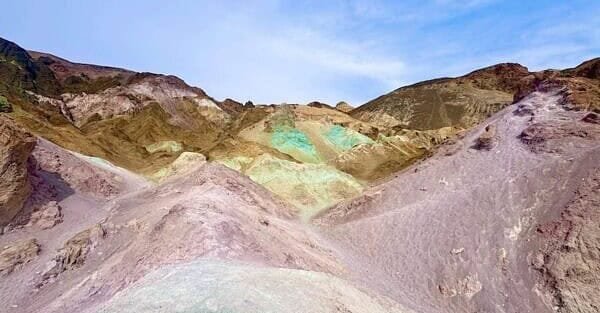
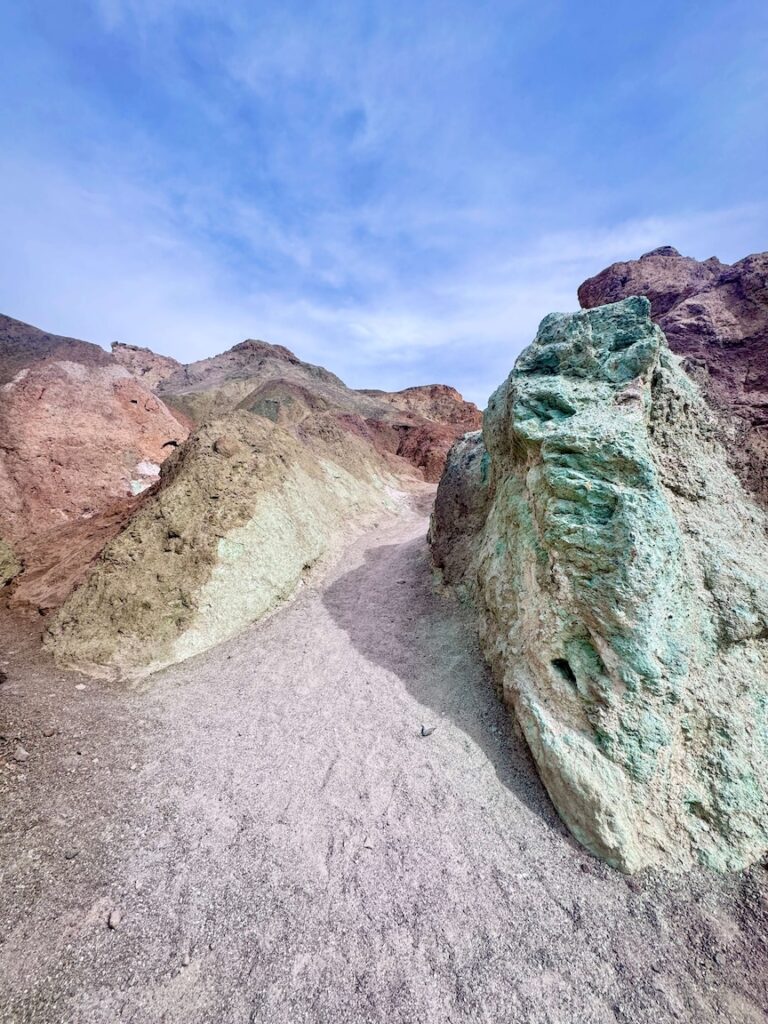
Most of Death Valley runs in earth tones. Browns, tans, grays, the occasional rust red. Then you turn a corner on Artist’s Drive and the hills just go full surreal. Pink. Green. Yellow. Purple. Swaths of color stacked in bands across the hillsides like someone decided the desert needed an intervention. It’s one of the most visually disorienting spots I’ve stood in, and I mean that as a high compliment.
Here’s your complete guide to visiting Artist’s Palette.
Quick Facts
| Site Name | Artist’s Palette |
| Location | Death Valley National Park, California |
| Coordinates | 36.3643° N, 116.8011° W |
| Distance | 0.3 miles (short loop/out and back) |
| Elevation Gain | 104 ft |
| Difficulty | Easy |
| Time | 20–45 minutes |
| Dogs Allowed | No (pets not permitted on park trails) |
| Fee | $35 per vehicle (7-day pass) or America the Beautiful Pass |
| AllTrails | View on Alltrails |
How to Get There
Artist’s Palette sits along Artist’s Drive, a 9-mile one-way scenic loop that branches off Badwater Road south of Furnace Creek. From Furnace Creek, head south on Badwater Road for about 10 miles and turn left onto Artist’s Drive at the signed entrance. The road runs one direction only, so you’ll exit back onto Badwater Road at the far end.
Artist’s Drive is paved and in good condition, but it’s narrow with tight curves through the badlands. Standard passenger vehicles, trucks, and smaller camper vans handle it fine. Estes drove it without issue. Large RVs and vehicles with trailers are not recommended and may not be able to navigate the tighter sections.
Death Valley National Park charges $35 per vehicle for a 7-day pass. The America the Beautiful Annual Pass covers entry. Pay at the entrance stations or in advance through recreation.gov.
Parking Information
There’s a designated parking area at Artist’s Palette with space for a reasonable number of vehicles. It fills during peak hours, especially around sunset on weekends in the November to March season. Get there 30 to 45 minutes before golden hour to secure a spot and get positioned before the light starts moving.
No water and no restrooms at the Artist’s Palette stop. The nearest facilities are back at Furnace Creek. Plan accordingly and bring everything you need before turning onto Artist’s Drive.
Cell Service and Navigation
Cell service along Artist’s Drive is limited to nonexistent. The canyon terrain and distance from cell infrastructure kill most signals reliably. Don’t count on data or navigation once you’re on the loop road.
Artist’s Drive is a one-way loop with no decision points, so navigation isn’t a real concern. Download offline maps for the Death Valley area before entering the park and have them accessible. For the short walk at Artist’s Palette, you won’t need navigation, but it’s good practice for the broader area.
What to Expect at Artist’s Palette
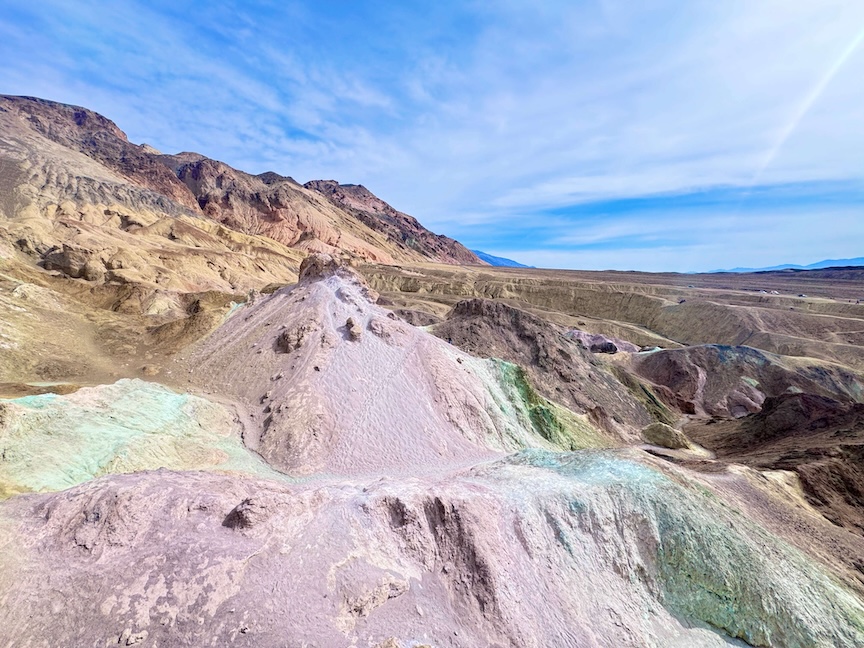
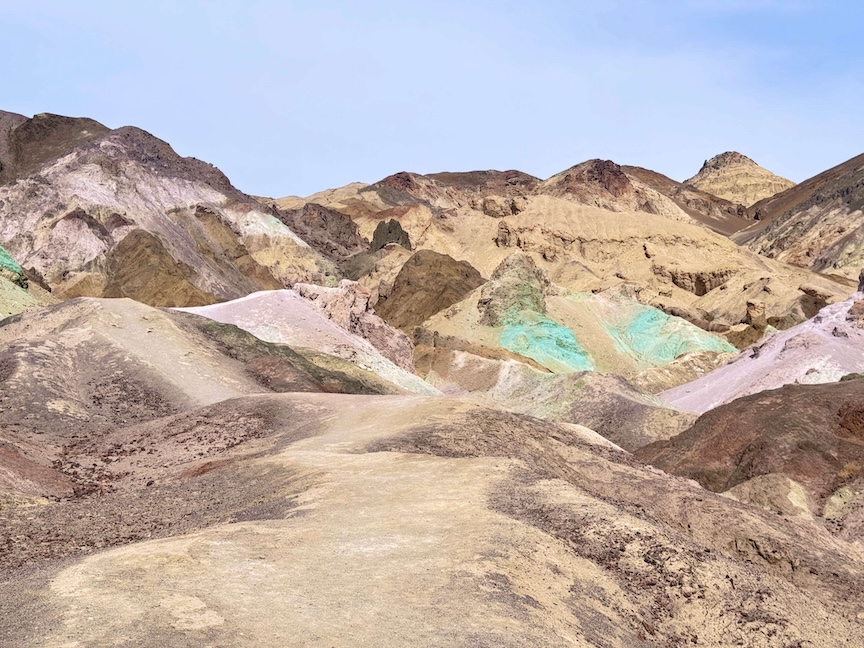
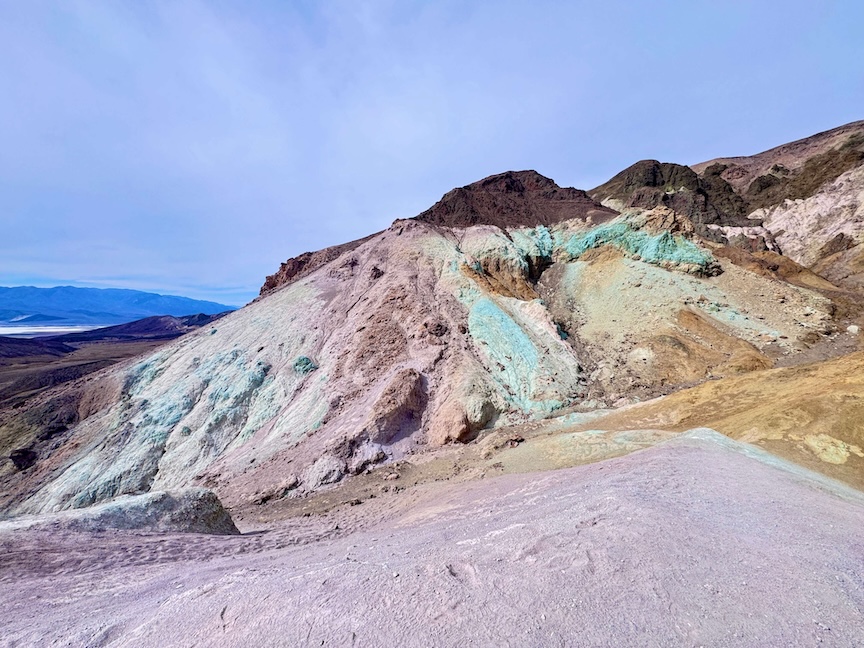
The color at Artist’s Palette comes from volcanic minerals oxidized and exposed by millions of years of erosion. Iron oxides produce the reds, pinks, and yellows. Manganese creates the purples. Decomposed mica gives the greenish tones. The hills are layered deposits of these different minerals, which is why the color appears in distinct bands rather than blended gradients.
The range of color in a small area is genuinely unusual. Most geological color displays in the American West lean red and orange. Artist’s Palette runs the full spectrum, greens sitting next to purples sitting next to pinks, and the contrast between them is stark and strange. It looks altered. First-time visitors often instinctively assume it’s been photographically enhanced. It hasn’t.
The intensity of the colors shifts dramatically with light angle and cloud cover. Midday sun washes them out. Overcast days mute the contrast. Golden hour, especially evening light hitting the hills from a low western angle, is when the colors are at maximum saturation. That’s the visit worth planning around.
The official distance at Artist’s Palette is 0.3 miles with 104 feet of elevation gain. It’s a short, easy walk from the parking area down into and around the colored hills. The terrain is soft and uneven, with no formal marked trail. You pick a direction and wander among the formations.
The hills are small enough to walk around completely in under 30 minutes. Most visitors spend 20 to 45 minutes here, some moving quickly through for photos, others sitting and watching the light shift. Both are valid approaches. This isn’t a destination that rewards rushing, but it also doesn’t require a long commitment.
Footing on the soft mineral deposits is uneven. The surface crumbles slightly underfoot in places. Wear closed-toe shoes with decent grip. Sandals are uncomfortable on this terrain.
Artist’s Palette is one of those rare spots where the difference between mediocre and extraordinary is entirely about timing. Visit at 2 p.m. and you’ll see interesting hills. Visit at 4:30 p.m. in November and you’ll see something that looks like a hallucination.
The hills face generally east and west, which means morning light hits the western-facing slopes and evening light saturates the eastern-facing ones. For most visitors making a day-trip circuit of Death Valley’s highlights, late afternoon on the way back north is the natural timing for Artist’s Palette. That also happens to be the right timing for the best light.
Bring a polarizing filter. It cuts the glare on the mineral surfaces and punches up the color contrast in ways that a standard UV filter won’t. Shooting toward the light rather than with it often produces the more interesting results here, the backlit edges of the hills glow differently than the front-lit faces.
Trail Difficulty and Length
Artist’s Palette covers 0.3 miles with 104 feet of elevation gain. It’s easy. The short walk involves gentle up-and-down movement on soft, uneven terrain. No scrambling, no exposure, no navigation challenge.
This is a sightseeing stop first, a hike second. Even visitors who don’t think of themselves as hikers handle it comfortably. The main physical variable is heat, which in the wrong season makes even a short walk genuinely dangerous. Come in the cooler months and you’ll be fine.
Dog Friendly?
No. Pets are not allowed at Artist’s Palette or most areas within Death Valley National Park.
The heat and terrain make Death Valley a difficult environment for dogs at most times of year regardless. Leave them somewhere safe and cool.
What to Bring
Artist’s Palette is a short stop, but Death Valley still demands basic preparation.
Water, even for a 20-minute visit. The dry desert air dehydrates you faster than you expect, especially in the cooler months when you don’t notice you’re sweating. Carry at least half a liter per person for the walk.
Sun protection: sunscreen, hat, and sunglasses. The terrain has no shade.
For photography, a polarizing filter is the single most impactful piece of gear you can bring to Artist’s Palette. Wide-angle lens for the hillside compositions. A mid-range zoom to isolate individual color bands. Tripod optional, but useful if you’re shooting in the last minutes of golden hour when light drops fast.
Closed-toe shoes with grip. The soft mineral deposits underfoot are uneven and a little unpredictable.
Best Time to Visit Artist’s Palette
November through March is the right window for Death Valley. Summer temperatures make even a short outdoor stop potentially dangerous. The colors don’t change seasonally, the light quality does.
Late afternoon is the best time of day. Budget your Artist’s Drive visit for the final 2 hours of daylight. The one-way road means you can plan your timing to arrive at the Artist’s Palette stop just as the light is getting good. Don’t rush the drive in, the rest of Artist’s Drive has worthwhile scenery too.
Weekdays are less crowded than weekends throughout the peak season. If golden hour at Artist’s Palette is a photography priority, a weekday visit gives you the parking lot and the hills mostly to yourself.
Overcast days mute the colors significantly. Clear skies are the condition you want. Check the forecast before driving out from Furnace Creek.

Rules and Regulations
Death Valley National Park rules apply at Artist’s Palette and along Artist’s Drive.
Stay on existing paths and minimize your footprint on the fragile mineral deposits. The color in these hills is the result of geological processes taking millions of years. Off-trail foot traffic causes real, lasting damage.
Do not collect rocks, minerals, or any natural material. It’s a federal offense in a national park and the park actively enforces it.
Leave No Trace throughout. Pack out everything you bring in. No trash cans at the Artist’s Palette stop.
Where to Stay Near Artist’s Palette
Furnace Creek is the closest base, about 10 miles north on Badwater Road. The Inn at Death Valley and the Ranch at Death Valley are both there. The Inn is a historic, higher-end property; the Ranch is more casual and family-friendly.
For loyalty program options in the broader region, Marriott Bonvoy and Hilton Honors cover properties in Las Vegas (roughly 2 hours east) and Ridgecrest (roughly 2 hours west), the two most common staging cities for Death Valley trips. IHG Rewards has options along both corridors as well.
Camping Nearby
Furnace Creek Campground is the main developed campground in this part of the park, with hookup and non-hookup sites. It’s the most popular campground in Death Valley and books out weeks in advance during the November to March window. Reserve through Recreation.gov.
Texas Spring Campground is a quieter alternative near Furnace Creek at slightly higher elevation, with tent and vehicle sites and no hookups. Worth checking if Furnace Creek is full.
Dispersed backcountry camping is allowed in designated undeveloped areas of Death Valley at least 1 mile from paved roads, 100 yards from water and trails, with a free permit. Check current restrictions with the park before planning sites near the Badwater Road corridor.
Nearby Adventures
Artist’s Palette anchors the southern half of a natural Death Valley day loop that hits several of the park’s most distinctive stops.
Badwater Basin is about 8 miles south on Badwater Road. The lowest point in North America at 282 feet below sea level. The salt flat walk is short and completely unlike anything else in the park.
Dante’s View is accessible via CA-190 east of Furnace Creek, about 25 miles from the Artist’s Drive turnoff. The overlook sits at 5,475 feet and puts the entire valley, including Badwater Basin below and the Panamint Range across, in a single frame. See my Dante’s View guide for timing and photography details.
Golden Canyon and Gower Gulch Loop via Zabriskie Point is the park’s best full-day hike, 6.4 miles with 1,082 feet of gain through badlands, canyon narrows, and the Red Cathedral formation. The trailhead is about 2 miles south of Furnace Creek on Badwater Road. Read my Golden Canyon guide for the full breakdown.
Zabriskie Point is a short walk to a badlands overlook about 5 miles east of Furnace Creek on CA-190. Best at sunrise. Easy to combine with an Artist’s Drive afternoon if you’re doing a full day of Death Valley highlights.
Mosaic Canyon Trail is about 35 miles northwest near Stovepipe Wells, the park’s best slot canyon hike. Polished marble narrows and tight canyon walls. See my Mosaic Canyon guide for the details.
AllTrails has Artist’s Palette mapped with user-reported conditions and an offline map download. The walk is short and the area is small, but having the offline map loaded gives you context for the broader Artist’s Drive loop and the surrounding terrain.
Check the Death Valley National Park website for any road closures on Artist’s Drive before heading out, the narrow road occasionally closes for maintenance or after significant weather events. View on Alltrails
Chase the Quiet
There’s a specific kind of quiet you find when the light is dying and you’re standing alone in a hillside painted colors that have no business existing in a desert. The green next to the purple next to the pink, all of it going warm and deep in the last few minutes of sun. Artist’s Palette in that window is one of those places where the usual mental noise just stops. The visual input takes up all the bandwidth. I’ll take that trade every time.
Support the Adventure
To make your walls less boring, check out my photography portfolio and bring a piece of the wild and my story into your home.
If you’d like to fuel future adventures, you can donate a coffee on Ko-Fi. Every cup keeps me chasing sunrises and stories.
When you shop using my affiliate links, every click helps support this blog at no extra cost to you. It’s a small way to keep Unicorn Adventure alive and kicking while I keep exploring.
Subscribe to my mailing list for future updates, new stories, and behind-the-scenes adventures.
Stay connected with me on Instagram and Facebook for more photos and daily inspiration.
Thanks for being part of the journey, Unicorn Squadron!
Theo Maynard is a landscape photographer and adventure blogger based in Salt Lake City. He chases remote desert and mountain light across the American West, documents it all solo, and shares the journey through Unicorn Adventure. He’s on the autism spectrum, and that’s not a footnote, it’s the whole story. He creates to inspire others to get outside, chase what lights them up, and live their best possible life. Unapologetically himself.