
Death Valley has a reputation. Hottest place in North America. Driest. Most extreme. People treat it like a warning label instead of an invitation. I’ve never understood that. Extreme is interesting. Extreme is worth loading up Estes and driving toward.
This trip gave me sand dunes and slot canyons, a mountain campsite that wrecked me emotionally in the best possible way, a stranger from my hometown in a Death Valley parking lot, and enough wide open desert quiet to reset something that had been running too loud for too long.
Here’s how it went.
Mesquite Flat Sand Dunes: Where Trails Go to Die
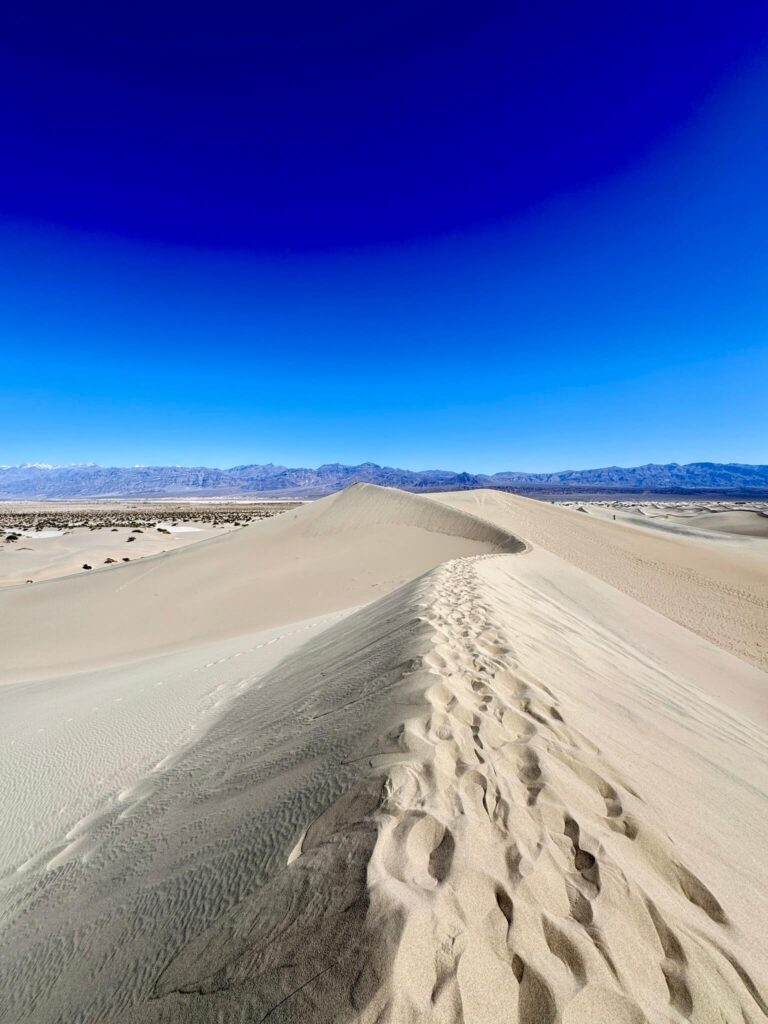
There’s no trail at Mesquite Flat Sand Dunes. Just an open field of soft, foot-sinking sand and the general understanding that the tallest dune is somewhere out there and you’re going to have to earn it.
I went in warm conditions. Every step sank. The backpack added its own opinion. The climb to the high dune was slow, sweaty, and genuinely harder than it looks from the parking lot, which is famously deceptive. The sand gives way under you constantly. You work twice as hard as the distance suggests.
The top was worth it. Mountains on the western horizon, golden sand in every direction, and silence so complete it almost had texture. That specific kind of desert quiet that Death Valley does better than anywhere. I stood there longer than I planned. Then I picked a line and walked back down, which is the best part of any sand dune.
Full planning guide: Mesquite Flat Sand Dunes Trail Guide.
Mosaic Canyon: Polished Walls and Zero Dignity
After the dunes, I drove over to Mosaic Canyon near Stovepipe Wells. The 2.3-mile washboard access road shakes everything in the car loose, including your confidence. Then you step into the canyon and immediately forgive it.
The lower narrows are the reason people come here. Polished dolomite marble, worn smooth by centuries of flash floods, curving in shapes that look sculpted. The walls are cold in the morning and catch the light differently depending on where you’re standing. It’s genuinely extraordinary geology presented at eye level.
Then the canyon tightens, the dry falls start showing up, and the scrambling begins. I hauled myself over boulders, squeezed through gaps, found the path of least resistance on multiple surfaces that didn’t offer much of one. There were moments involving more creative movement than I’d like to describe. I was laughing through most of it. Pure, messy, physical fun in a slot canyon. That’s exactly what this trail is.
Full planning guide: Mosaic Canyon Trail Guide.
The Drive: No Signal, No Plan, No Problem
After Mosaic Canyon, my legs made their position clear. Done. I decided to call the hiking day and head to camp. What I hadn’t fully accounted for was how far the campsite actually was and that Death Valley’s cell service situation would make navigation an exercise in improvisation.
I drove. No GPS, no signal, just the road and whatever was on the other side of it. The drive turned out to be one of the better parts of the trip. Open desert transitioning into the Owens Valley, jagged cliffs rising on both sides, a sky that went on in every direction without obstruction. The kind of drive that reminds you why road trips exist.
By the time I found a site, the good spots were mostly claimed. Except one.
Alabama Hills: The One That Got Me
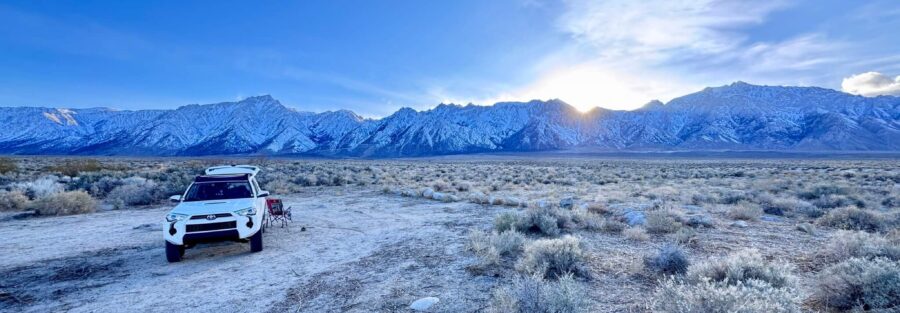
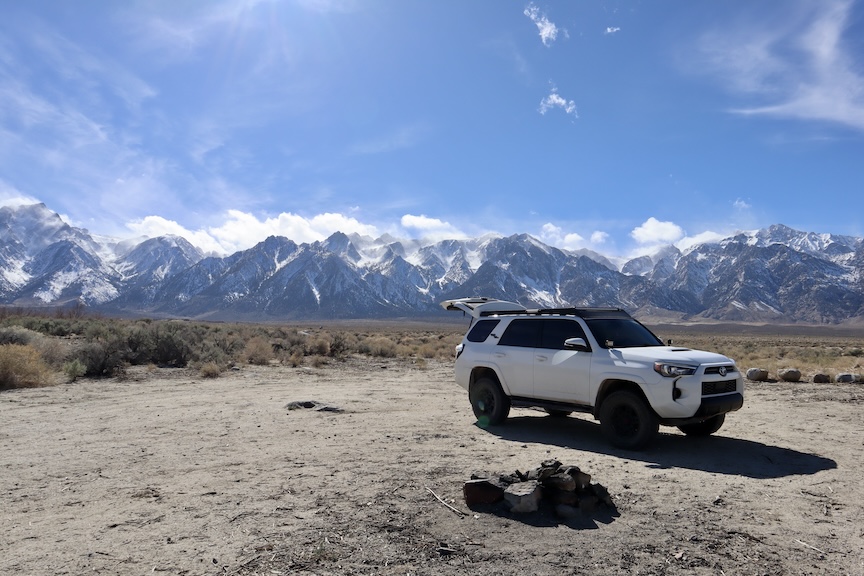
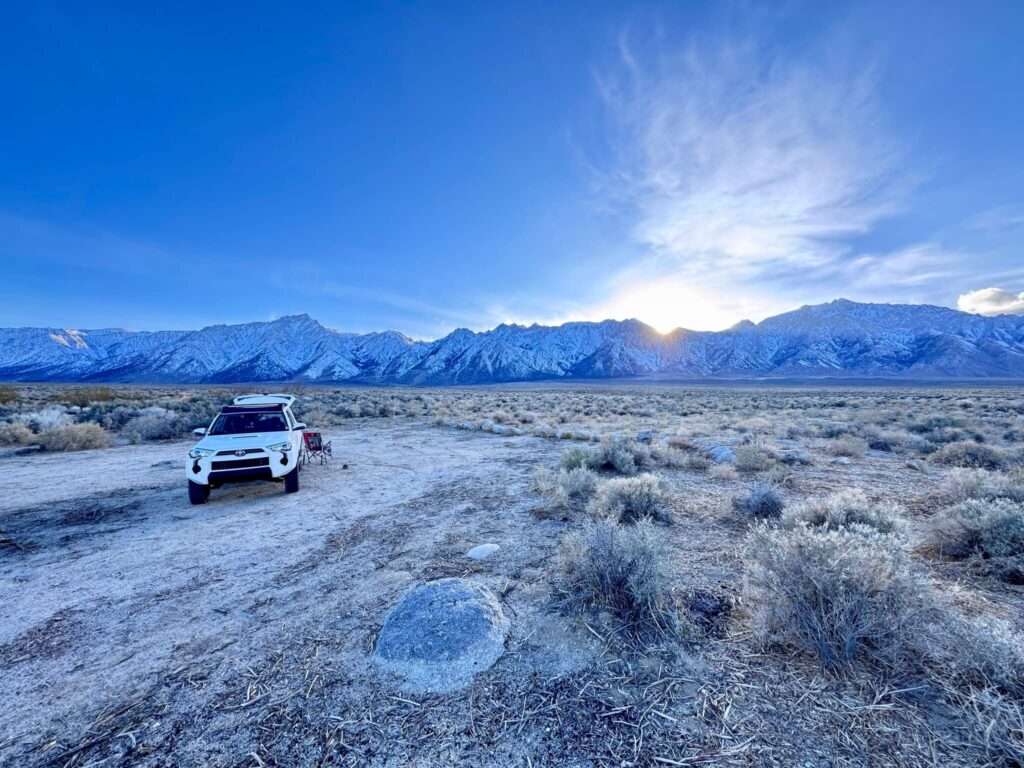
Alabama Hills, outside Lone Pine, California, with the Sierra Nevada rising directly behind it, is one of those places that hits you before you’ve fully processed what you’re looking at. The rounded granite boulders in the foreground, the 14,000-foot peaks behind them, a small stream running through the campsite. I stood next to Estes for a full minute before I moved.
I’m autistic, and I experience joy in a specific way sometimes, a full-body, zero-filter, completely uncontained burst that I’ve started calling the autistic zoomies. Alabama Hills triggered it hard. I went live on Instagram. I talked to friends. I fixed something on the car that had been annoying me. I cooked dinner while the sun went behind the peaks and the light went pink and then purple on the rocks around me.
That night by the fire was one of those nights. The kind where everything is exactly as it should be and you know it while it’s happening, which is rare. I thought about staying an extra day. I still think about that. It was the most emotionally complete evening I’ve had on the road in a long time.

Dante’s View: Best Morning View in the Park
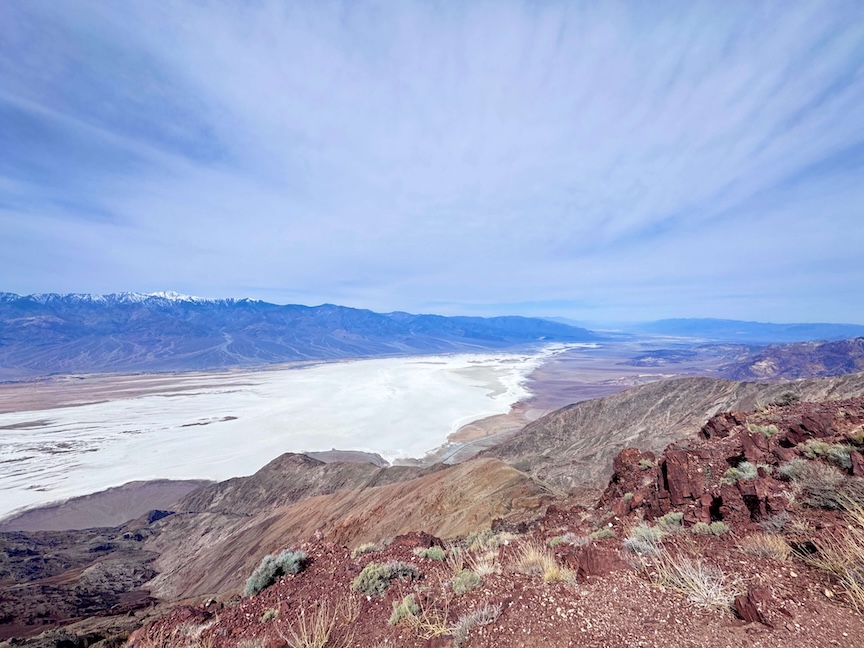
The next morning started at Dante’s View. The 13-mile drive up the Black Mountains switchbacks is paved and steep, and you arrive at 5,475 feet with the entire Death Valley basin opened up below you.
Badwater Basin sits almost directly underneath the overlook, 282 feet below sea level, visible as a white smear on the valley floor nearly a mile below where you’re standing. The Panamint Range fills the western horizon. On a clear morning, you can pick out Mount Whitney.
Short ridgeline walk, big views, genuinely humbling scale. A perfect way to start a Death Valley morning before the heat builds. I moved on while I was still feeling good.
Full planning guide: Dante’s View Trail Guide.
Zabriskie Point to Golden Canyon: Packed Lots and a Hometown Stranger
The Zabriskie Point parking lot was full. That’s the reality of Death Valley’s most photographed overlook on a weekend morning in peak season. I was skeptical about the whole stop until I noticed that almost nobody was actually hiking beyond the overlook. The Golden Canyon loop stretched out below with almost no one on it.
The Golden Canyon and Gower Gulch Loop is 6.4 miles through golden narrows, past Red Cathedral, over the badlands to Zabriskie, and back out through Gower Gulch. It’s Death Valley’s best full-day hike and it mostly goes unappreciated by the crowd standing 50 feet away taking the same photo.
About halfway through the trail, a guy clocked my Green Bay Packers shirt and stopped. Turns out he was from Madison, Wisconsin. My hometown. We stood in the middle of a Death Valley canyon talking about high school neighborhoods and old spots we both remembered, two people from the same place meeting on opposite sides of the continent in one of the most remote parks in America. The world does that sometimes.
Full planning guide: Golden Canyon and Gower Gulch Loop Trail Guide.
Artist’s Palette: Bob Ross Built This
On the way to the next camp, I turned onto Artist’s Drive for a quick stop at Artist’s Palette. I’d seen photos. Photos don’t cover it.
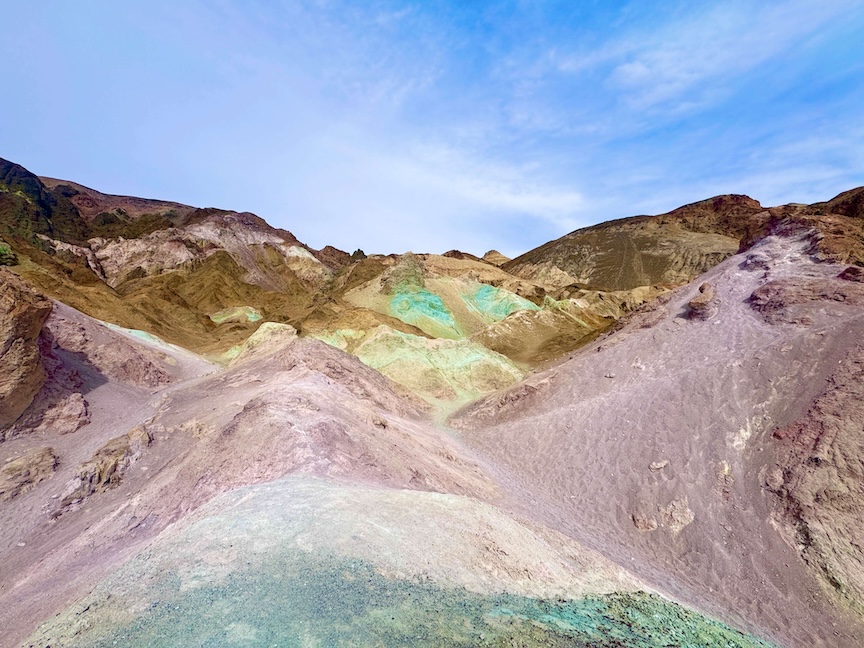
The hills are streaked with colors that have no business existing in a desert: pink, green, purple, yellow, all from volcanic mineral deposits oxidized over millions of years. Midday light isn’t ideal for the colors, but even in flat light the contrast between the shades is wild. I moved fast through it, shooting as I went, grinning at the fact that this is a real place that exists and I was standing in it.
Late afternoon light is the real move here. If you can time your visit to Artist’s Drive in the final two hours of the day, the colors go fully saturated and the hills look like something painted rather than eroded. Add it to every Death Valley itinerary without hesitation.
Full planning guide: Artist’s Palette Guide.

Shoshone: Quiet Night, Good Reset
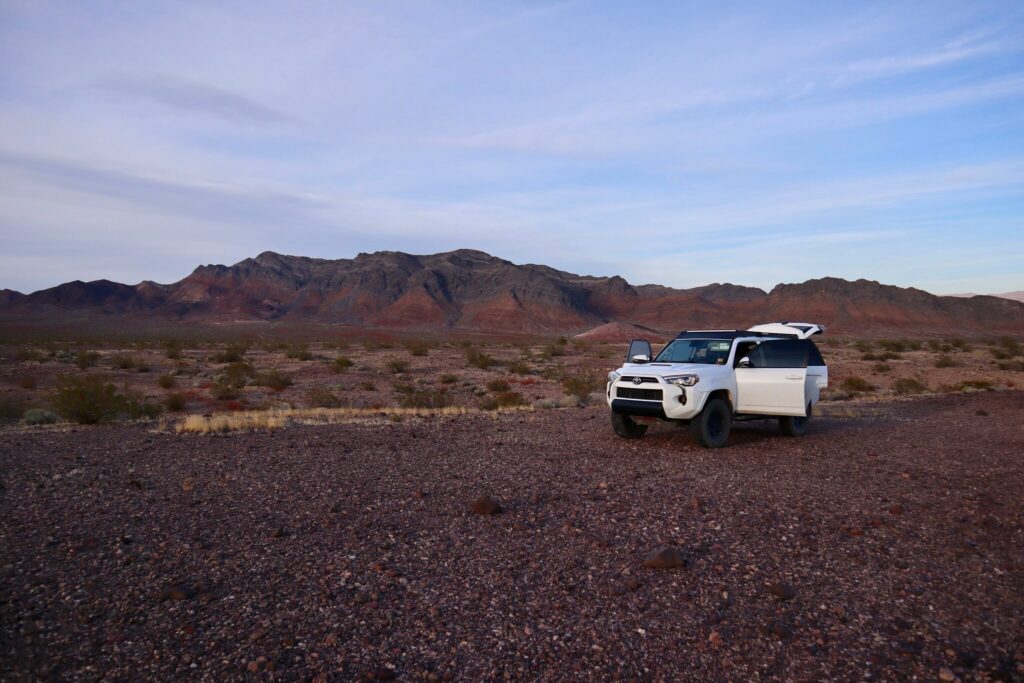
I ended the trip camped near Shoshone, the small desert community on the southern edge of Death Valley. Not as dramatic as Alabama Hills. Not trying to be. The night was calm and dark, the kind of dark you only get 50 miles from the nearest town, and the quiet was complete.
Some nights on a trip are for the experience. Some are just for rest and reflection. Shoshone was the second kind. Good views, good fire, good end to a trip that had given me more than I came looking for.
Final Thoughts
Death Valley is not a warning label. It’s an invitation to a landscape that operates at a different scale than anything in your daily life. It will challenge you physically, strip away the noise, and occasionally hand you a moment so good you’ll still be thinking about it months later by a campfire that isn’t there anymore.
The Alabama Hills night. The Madison stranger in Golden Canyon. The silence on top of the dunes. The polished marble walls catching morning light in Mosaic Canyon. Those don’t fit in a summary. They just sit in memory, intact.
I’ll be back. Different season, different route, same Estes.
Chase the Quiet
Death Valley gave me five days of exactly what I chase: the places that still feel wild, the moments that don’t fit in a caption, and the specific kind of quiet that only exists when you’re far enough from everything familiar that your brain stops filling in the background noise with things it invented.
Support the Adventure
To make your walls less boring, check out my photography portfolio and bring a piece of the wild and my story into your home.
If you’d like to fuel future adventures, you can donate a coffee on Ko-Fi. Every cup keeps me chasing sunrises and stories.
When you shop using my affiliate links, every click helps support this blog at no extra cost to you. It’s a small way to keep Unicorn Adventure alive and kicking while I keep exploring.
Subscribe to my mailing list for future updates, new stories, and behind-the-scenes adventures.
Stay connected with me on Instagram and Facebook for more photos and daily inspiration.
Thanks for being part of the journey, Unicorn Squadron!
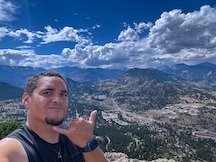
Theo Maynard is a landscape photographer and adventure blogger based in Salt Lake City. He chases remote desert and mountain light across the American West, documents it all solo, and shares the journey through Unicorn Adventure. He’s on the autism spectrum, and that’s not a footnote, it’s the whole story. He creates to inspire others to get outside, chase what lights them up, and live their best possible life. Unapologetically himself.