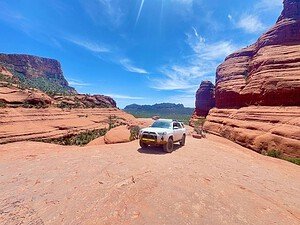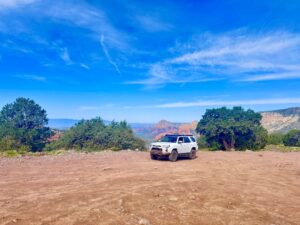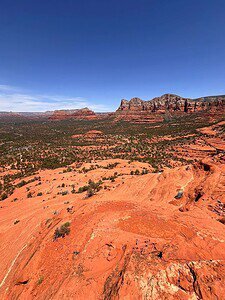
Two miles. That’s it. And yet the Birthing Cave trail delivers more in those two miles than most Sedona hikes twice its length. You walk flat desert through juniper and red rock buttes, hit an unmarked spur that the majority of hikers walk right past, scramble up a steep rocky face, and step into a wide sandstone alcove with canyon views opening out in front of you. The cave itself is a natural formation that has held cultural and spiritual significance for Native communities in this region for centuries. Arriving there with some awareness of that history changes the experience. Places that carry that kind of layered weight, natural beauty plus deep human history, tend to hit differently. I found the unmarked spur on a second pass after walking past it the first time. That’s part of the trail’s character. It doesn’t announce itself. You have to pay attention.
Quick Facts
| Location | Coconino National Forest, Sedona, Arizona |
| Coordinates | 34.9067, -111.8242 |
| Distance | 2 miles (out and back) |
| Elevation Gain | 250 ft |
| Difficulty | Moderate |
| Time | 1.5 hours |
| Dogs Allowed | Yes, on leash. The cave scramble is not suitable for most dogs. |
| Fee | Red Rock Pass required ($5/day or $15/week); America the Beautiful Pass accepted |
| Plan This Hike on AllTrails | |
How to Get There
The Birthing Cave trailhead sits off Long Canyon Road, about 15 minutes northwest of downtown Sedona. Take AZ-89A west from Sedona and turn right onto Dry Creek Road. At the T-intersection, turn left onto Long Canyon Road. After about half a mile, watch for a small dirt pull-off on the left. There is no large trailhead sign for Birthing Cave specifically. The pull-off marks the Long Canyon Trailhead, which is where the Birthing Cave spur begins. Your GPS should route you to the Long Canyon Trailhead. If you’re using AllTrails or Gaia GPS with the Birthing Cave route loaded, the spur junction will be marked. Without a loaded track, the turnoff is easy to miss.
Parking Information
Parking is a dirt shoulder pull-off with space for roughly a dozen vehicles. No formal lot. No kiosk on-site. A Red Rock Pass or America the Beautiful Pass is required. If you don’t have a pass, the nearest kiosk is back toward Sedona. Arrive early on weekends and during peak season. The pull-off fills by mid-morning on busy days. Do not block the road or private driveways. Rangers patrol this area and will ticket. No shuttle service runs to this trailhead. 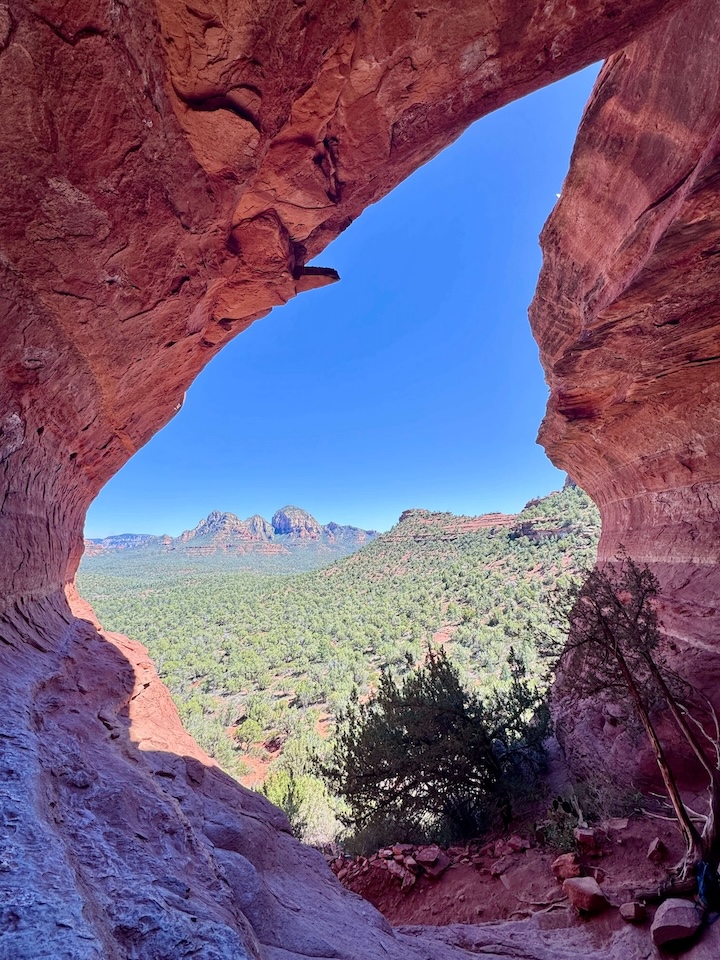
Cell Service and Navigation
Coverage on Long Canyon Road is limited. Verizon and AT&T both lose signal in the canyon corridor. The trail’s main navigation challenge is finding the unmarked spur to the cave, which is about 0.6 miles in. Download the AllTrails route or a Gaia GPS track with the Birthing Cave spur marked before you leave Sedona. Do not count on finding the junction by sight alone on a first visit. Having the GPS track running makes the difference between finding the cave and hiking past it.
What to Expect on the Birthing Cave Trail
The Approach
The trail follows Long Canyon Trail through open red rock desert. Wide sandy path, juniper trees, prickly pear cactus, and the canyon walls building on both sides as you move northwest. The walking is easy and flat, a warm-up that gives you no hint of what’s coming. At about 0.6 miles, a faint use-trail branches left into the rocks. That is the Birthing Cave spur. It is unsigned. If you’re not watching your GPS, you will walk past it. Most people do on the first try.
The Scramble
Once you turn onto the spur, the terrain changes immediately. The path climbs a steep red rock face to reach the cave entrance, maybe 100 to 150 feet of scrambling on loose and slick sandstone. Hands are required. The grade is steep enough that coming back down demands more care than going up. Good grip soles make a real difference here. Take your time both ways.
The Cave
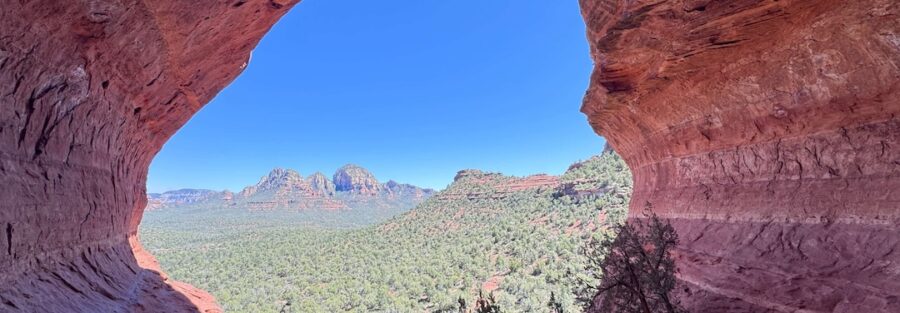
The Birthing Cave is a wide, shallow sandstone alcove set into the cliff face. The opening frames the canyon below and the red rock buttes beyond it in a natural arch shape. Light inside the cave is diffuse and warm, reflected off the sandstone walls. The space feels quiet in a way that goes beyond just the absence of noise. This site is considered sacred by Native American communities in the region. That history is present whether you acknowledge it or not. Sit with it, keep your voice low, and leave the cave exactly as you found it. No cairns, no graffiti, no collecting anything from the rock.
Trail Difficulty and Length
The Birthing Cave Trail is 2 miles round trip with 250 feet of elevation gain. The Long Canyon approach section is easy and flat. The cave scramble is the crux, steep, slippery in spots, requiring hands for balance and solid footwork on the way back down. The overall trail is moderate primarily because of that final scramble. If you are comfortable with basic hands-on scrambling and not intimidated by some exposure, this is well within reach. Grip soles are not optional.
Dog Friendly?
Dogs are allowed on leash for the approach section along Long Canyon Trail. The cave scramble is not suitable for most dogs. The steep grade and slick sandstone are difficult for four-legged animals to navigate safely, and the drop-offs on the approach to the cave make a slipping dog a real concern. If you bring your dog, plan to leave them at the base of the scramble while you climb. Bring water for the approach, no sources on the trail, and pack out all waste.
What to Bring
A liter of water minimum. Sunscreen and a hat for the exposed approach. Hiking shoes or trail runners with serious grip, the cave scramble is where footwear matters most. A camera. The cave opening frames the canyon in a way that rewards a wide lens. Approach early before it warms up. The cave itself stays cool but the south-facing scramble collects heat fast in the midday sun.
Best Time to Hike the Birthing Cave Trail
Spring (March through April) and fall (October through November) are the best seasons. Cooler temperatures, good desert light, manageable crowds. Summer demands an early start, the scramble faces south and bakes in the afternoon. Be at the cave and heading back by 10 a.m. in July and August. Winter is peaceful and less crowded, but ice on the scramble rock is a real hazard. Check conditions before committing if there has been recent precipitation or overnight freeze. Morning light is the best time for photography inside the cave, the angle sends warm light into the alcove from the east. 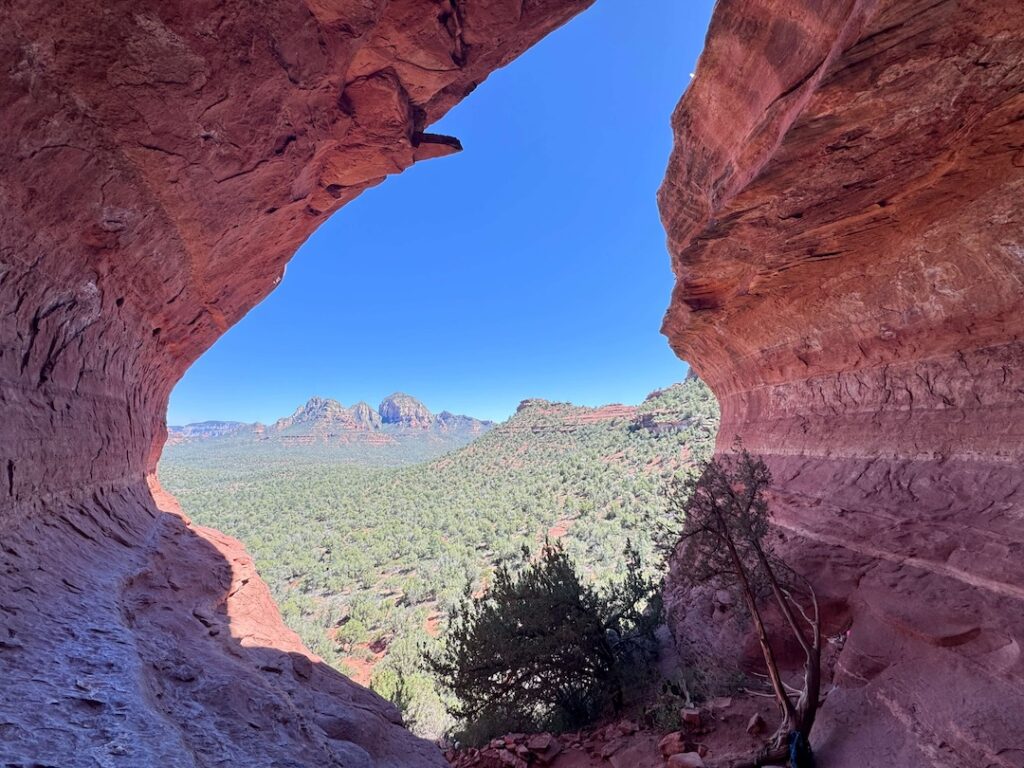
Rules and Regulations
The Birthing Cave sits within Coconino National Forest and holds cultural significance for Native American communities. Treat the space accordingly. Stay on the trail and the established scramble route. No rock stacking, no cairn building inside the cave or on the approach. No graffiti, no carving, no removing anything from the rock or the surrounding area. No loud music. No camping in the cave or on the approach. Pack out all waste. The cave is not a photo prop, it is a place. Visit it as a guest.
Where to Stay Near Sedona
The Enchantment Resort sits close to the Long Canyon Trailhead at the end of the Boynton Pass corridor. For points travelers, Marriott Bonvoy covers Sedona and the Verde Valley. IHG Rewards has properties in the broader region. Hilton Honors covers Hampton Inn and other options near Sedona. Uptown Sedona is the most convenient base for early morning trailhead starts and keeps you close to food and galleries for post-hike winding down.
Camping Nearby
Dispersed camping along Schnebly Hill Road is the closest free option in the Sedona area. The Fox Borough pull-offs offer open platforms with canyon views, free on Coconino National Forest land with a 14-day limit. Nolan Tank and Edge of the World are additional dispersed sites in the broader Sedona area accessible with high-clearance vehicles. No water, no hookups, no services at any dispersed site.
Nearby Adventures
Fay Canyon Trail is a few minutes east on Boynton Pass Road, 2.4 miles and 298 feet of gain with a hidden arch and canyon shade that makes it manageable even on warm days. Boynton Canyon Trail goes longer at 6.5 miles and 918 feet of gain with a vortex, the Subway Cave, and ancient ruins. Doe Mountain Loop is just down the road at 2.4 miles and 620 feet of gain with 360-degree mesa views. For non-hiking Sedona, the Amitabha Stupa and Peace Park near Long Canyon Road is a quiet stop that fits well with the tone of the Birthing Cave visit. The Chapel of the Holy Cross on AZ-179 is the landmark architectural stop. Airport Mesa at sunset is Sedona’s best free overlook and worth timing on the way back into town.
Plan This Hike
AllTrails has the Birthing Cave Trail documented with the spur junction marked, which is the most critical navigation point on this route. Download the offline map and have the track running before you leave the pull-off. The difference between finding the cave and missing it is a loaded GPS track at the right moment. Plan your hike on AllTrails here.
Chase the Quiet
I sat inside the Birthing Cave for ten minutes before heading back down. The canyon opened out in front of the alcove, red rock buttes catching the morning light, the trail below empty. The sandstone walls held the quiet well. I kept thinking about the centuries of use this place has seen, people coming here for reasons I will never fully understand, with a relationship to this land that goes incomparably deeper than a two-mile day hike. That weight is worth sitting with. It’s part of what makes this place worth visiting the right way.
Support the Adventure
To make your walls less boring, check out my photography portfolio and bring a piece of the wild and my story into your home. If you’d like to fuel future adventures, you can donate a coffee on Ko-Fi. Every cup keeps me chasing sunrises and stories. When you shop using my affiliate links, every click helps support this blog at no extra cost to you. It’s a small way to keep Unicorn Adventure alive and kicking while I keep exploring. Subscribe to my mailing list for future updates, new stories, and behind-the-scenes adventures. Stay connected with me on Instagram and Facebook for more photos and daily inspiration. Thanks for being part of the journey, Unicorn Squadron!
Theo Maynard is a landscape photographer and adventure blogger based in Salt Lake City. He chases remote desert and mountain light across the American West, documents it all solo, and shares the journey through Unicorn Adventure. He’s on the autism spectrum, and that’s not a footnote, it’s the whole story. He creates to inspire others to get outside, chase what lights them up, and live their best possible life. Unapologetically himself.